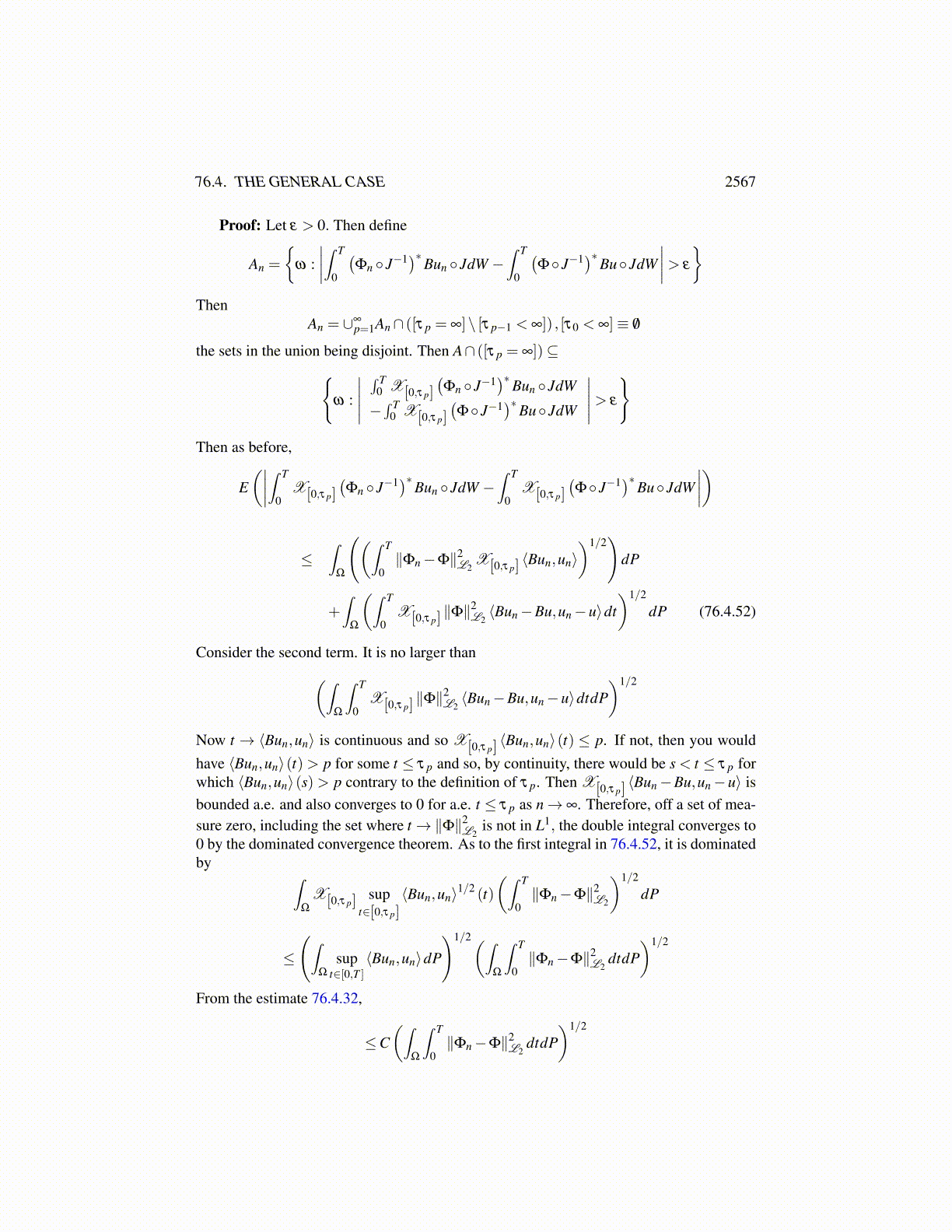
76.4. THE GENERAL CASE 2567
Hence we obtain
Bu(t)−Bu0 (ω)+∫ t
0A(ω)(u)ds =
∫ t
0f (s,ω)ds+B
∫ t
0ΦdW
This is a solution for a given ω /∈ N. Also, a stopping time argument like the above and thecoercivity estimates for A along with the implicit Ito formula show that u ∈ V . This yieldsthe existence part of the following existence and uniqueness theorem.
Theorem 76.4.7 Suppose V ≡ Lp ([0,T ]×Ω,V ) where p ≥ 2,with the σ algebra of pro-gressively measurable sets and Vω = Lp ([0,T ] ,V ).
Φ ∈ L2([0,T ]×Ω,L2
(Q1/2U,W
))∩L2
(Ω,L∞
([0,T ] ,L2
(Q1/2U,W
))),
f ∈ V ′ ≡ Lp′ ([0,T ]×Ω,V ′)
and both are progressively measurable. Suppose that
λB+A(ω) : Vω → V ′ω , λB+A : V → V ′
are monotone hemicontinuous and bounded where
A(ω)u(t)≡ A(t,u(t) ,ω)
and (t,u,ω)→ A(t,u,ω) is progressively measurable. Also suppose for p ≥ 2, the coer-civity, and the boundedness conditions
λ ⟨Bu,u⟩+ ⟨A(t,u,ω) ,u⟩V ≥ δ ∥u∥pV − c(t,ω) (76.4.46)
where c ∈ L1 ([0,T ]×Ω) for all λ large enough. Also,
∥A(t,u,ω)∥V ′ ≤ k∥u∥p−1V + c1/p′ (t,ω) (76.4.47)
also suppose the monotonicity condition for all λ large enough.
⟨(λB+A(ω))(u)− (λB+A(ω))(v) ,u− v⟩ ≥ δ ∥u− v∥α
U (76.4.48)
Then if u0 ∈ L2 (Ω,W ) with u0 F0 measurable, there exists a unique solution u(·,ω) ∈ Vω
with u ∈ V (Lp ([0,T ]×Ω,V ) and progressively measurable) such that for ω off a set ofmeasure zero,
Bu(t,ω)−Bu0 (ω)+∫ t
0A(s,u(s,ω) ,ω)ds =
∫ t
0f ds+B
∫ t
0ΦdW.
It is also assumed that V is a reflexive separable real Banach space.
Proof: The uniqueness assertion follows easily from the monotonicity condition.Now we remove the assumption that Φ ∈ L2
(Ω,L∞
([0,T ] ,L2
(Q1/2U,W
))). Every-
thing is the same except for the need for a different argument to show that∫ T
0
(Φn ◦ J−1)∗Bun ◦ JdW →
∫ T
0
(Φ◦ J−1)∗Bu◦ JdW