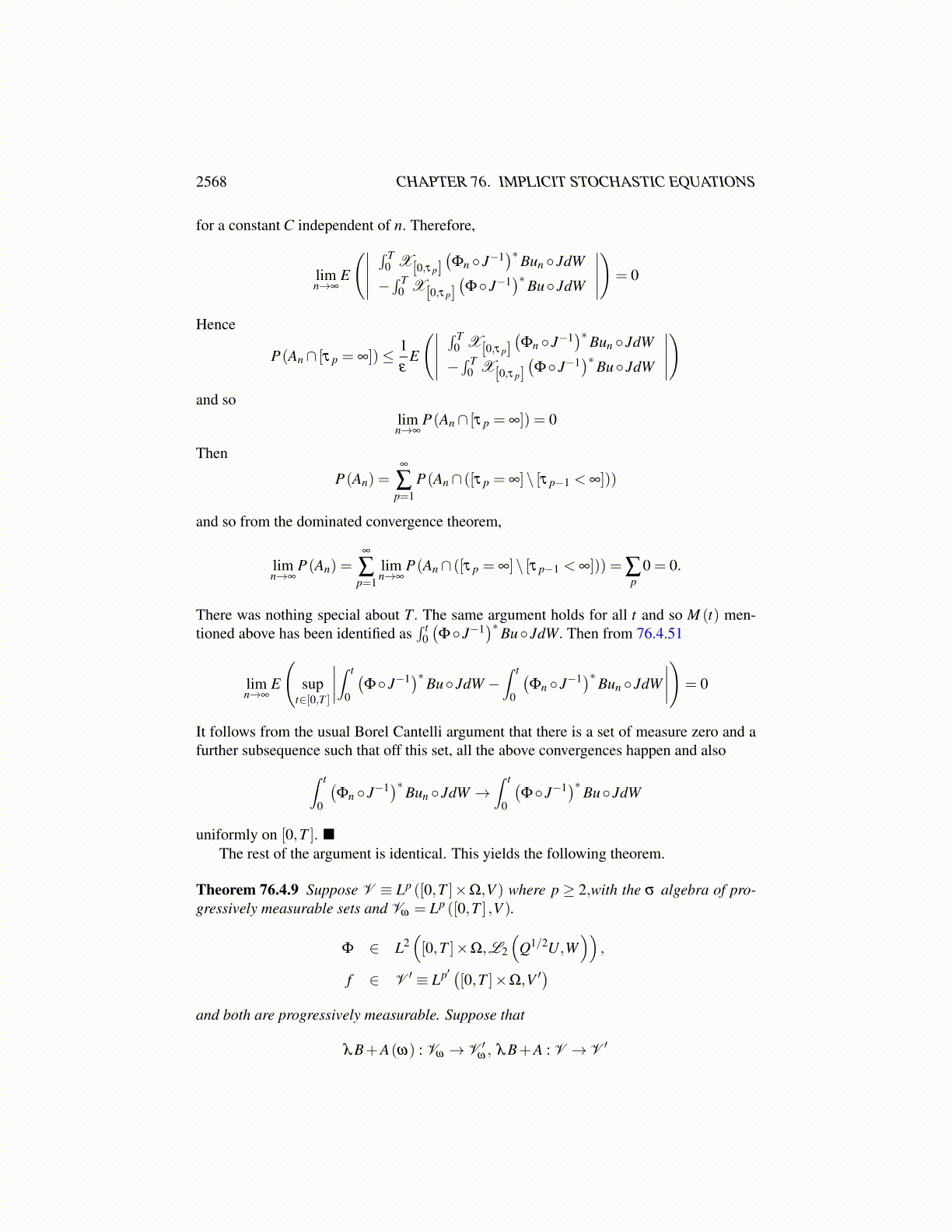
2568 CHAPTER 76. IMPLICIT STOCHASTIC EQUATIONS
In this case we assume
⟨(λB+A(ω))(u)− (λB+A(ω))(v) ,u− v⟩ ≥ δ ∥u− v∥2W
Then repeating the above argument with this change yields set of measure zero, still de-noted as N such that for ω /∈ N ∫ T
0∥un−un+1∥2
W ds≤ 2−n (76.4.49)
for all n large enough. Hence for such ω, un (·,ω) is Cauchy in L2 ([0,T ] ,W ) and infact un (t,ω) is a Cauchy sequence in W . Thus {un (·,ω)} converges in L2 ([0,T ] ,W ) tou(·,ω) ∈ L2 ([0,T ] ,W ) and by the above considerations involving continuous dependenceof V into W, it follows that u(·,ω) will be the same as the u from the above convergences.Now this convergence implies that in addition, for a.e. t,
limn→∞⟨Bun (t,ω)−Bu(t,ω) ,un (t,ω)−u(t,ω)⟩= 0 (76.4.50)
limn→∞
∫ T
0⟨Bun (t,ω)−Bu(t,ω) ,un (t,ω)−u(t,ω)⟩dt = 0
What is known from 76.4.35 is that for
Mn (t) =∫ t
0
(Φn ◦ J−1)∗Bun ◦ JdW
there is a continuous martingale M ∈M1T such that
limn→∞
E
(sup
t∈[0,T ]|Mn (t)−M (t)|
)= 0 (76.4.51)
Define a stopping time
τ p ≡ inf{
t : ⟨Bu,u⟩(t)+ supn⟨Bun,un⟩(t)> p
}This is a good enough stopping time because the function used to define it as a hitting timeis lower semicontinuous.
Lemma 76.4.8∫ T
0(Φn ◦ J−1
)∗Bun ◦ JdW →∫ T
0(Φ◦ J−1
)∗Bu◦ JdW in probability. Alsothere is a futher subsequence and set of measure zero such that off this set,
limn→∞
(sup
t∈[0,T ]
∣∣∣∣∫ t
0
(Φ◦ J−1)∗Bu◦ JdW −
∫ t
0
(Φn ◦ J−1)∗Bun ◦ JdW
∣∣∣∣)
= 0.
In particular, what is needed here is valid,
limn→∞
∫ T
0
(Φn ◦ J−1)∗Bun ◦ JdW =
∫ T
0
(Φ◦ J−1)∗Bu◦ JdW