Description:
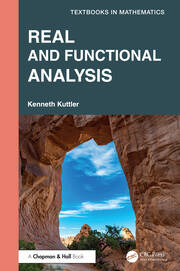
This unique book gives a manageable introduction to functional analysis and a thorough treatment of real analysis. Authored as a graduate textbook in analysis, the book could be used for a course in real analysis based on the Lebesgue theory of integration and/or a course on functional analysis.The author uses basic topological ideas to unify the presentation of the main ideas in analysis. He also includes connections to other fields, such as probability and differential equations, and adds some key background material.
Real and Functional Analysis presents topics not often found in standard books, such as an introduction to the area and coarea formulas, and a short introduction to probability featuring stochastic processes and martingales. It also gives a treatment of singular integrals and Mihlin’s theorem, including the Helmholtz decomposition as well as an introduction to multifunctions and their measurability.
Unlike other texts, which might offer complete proofs of the most difficult theorems and only a discussion of the ones that are not very hard, the author avoids this approach and includes a simple proof of the Brouwer fixed-point theorem, for example, which is often referred to with no proof given.
It is assumed the reader has studied a normed vector space, sometimes referred to as a linear space, along with the basic linear theorems, and has a working knowledge of basic set theory and the notation used in this subject. Otherwise, the book is essentially self-contained.
Many of the exercises extend the theorems and supply examples to illustrate the theorems proved in the book.
Description:
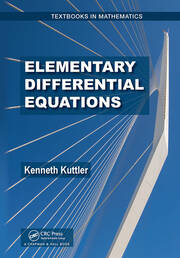
Elementary Differential Equations presents the standard material in a first course on differential equations, including all standard methods which have been a part of the subject since the time of Newton and the Bernoulli brothers. The emphasis in this book is on theory and methods and differential equations as a part of analysis.Differential equations is worth studying, rather than merely some recipes to be used in physical science. The text gives substantial emphasis to methods which are generally presented first with theoretical considerations following. Essentially all proofs of the theorems used are included, making the book more useful as a reference.
The book mentions the main computer algebra systems, yet the emphasis is placed on MATLAB and numerical methods which include graphing the solutions and obtaining tables of values.
Featured applications are easily understood. Complete explanations of the mathematics and emphasis on methods for finding solutions are included.

Description:
This is an introduction to linear algebra. It can be either before Calculus or after Calculus depending on the choice of chapters. The emphasis is initially on R^n and emphasizes row operations before abstract topics like vector spaces. The field of scalars is either the real numbers of the complex numbers.The picture on the inside is from Kenya, Tsavo Park in 1964
Description:
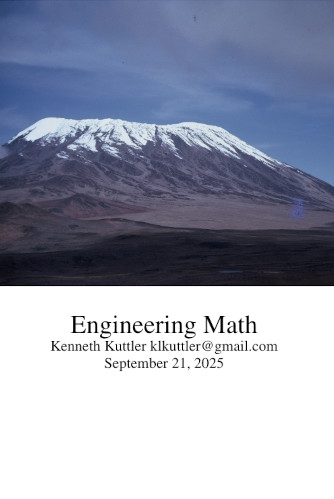
This is a presentation of topics which often appear in Engineering math courses. It has a short introduction to Statistics, Complex Analysis, Vector Analysis, and Linear Algebra.The picture is of Mt. Kilimanjaro from 1964.

Description:
This is an advanced calculus book which features one variable. It contains the major theorems about Fourier and Laplace transforms, the derivative and several approaches to integration including the Generalized Riemann integral. The emphasis is on the development of Analysis which took place in the nineteenth century. It also presents the construction of the Real Numbers from the Rational numbers due to Cantor which uses equivalence classes of Cauchy Sequences and an introduction to the classification of Real numbers. It has a short chapter on complex analysis considered in terms of a single complex variable.The picture is a waterfall in a botanical garden on the large Island of Hawaii.

Description:
This is a book for three semesters of Calculus. It is very different than most books in use in being much shorter, only about 700 pages. It includes proofs of all major topics in Calculus. It also has the major applications to mechanics.The picture is Mt. Kenya from some time between 1963 and 1965.

Description:
This is a more advanced treatment of the standard topics in Linear Algebra and is not contemplated as coming before Calculus. Like the elementary book, it mainly features the real and complex numbers. Determinants are introduced early in the book in conformance with the historical development of the subject. It discusses the advanced topics like canonical forms and their applications to topics like Markov Processes.The picture is of elephants in Amboseli Park in 1964
Description:
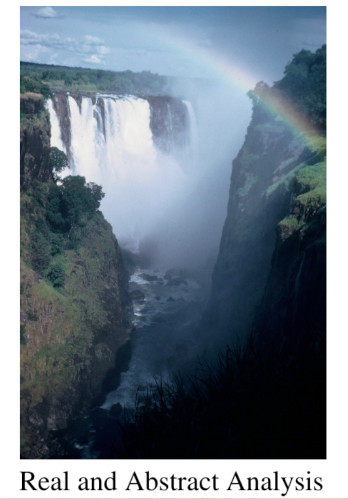
This is to follow Analysis of Functions of Many Variables. Probably, this book is too long. However, it has links which allow it to be navigated. It concludes with material on Stochastic Processes which I encountered in our seminar before retiring. It has major theorems on Fourier Analysis and geometric measure theory. It includes all the major topological theorems which are often encountered, often from several points of view and has an introduction to nonlinear analysis and includes set valued measurability and related topics. It has a treatment of paracompactness and general partitions of unity and related topics like metrizability.The picture was taken by my father around 1951. It is Victoria Falls.

Description:
This considers continuity, the derivative, and the integral for functions of many variables. The presentation is in terms of the Lebesgue integral and good change of variables theorems are presented. This book also includes a treatment of the difficult theorems in topology like the Brouwer Fixed Point Theorem and the Jordan Separation Theorem, the latter in the chapter on the topological degree. Like the book on analysis of functions of one variable, it has a short chapter on Complex Analysis. My Father took the picture on the front.It is the falls in Kenya on the Athi River early in 1964.

Description:
There are two parts to this book. The first part presents those parts of linear algebra as part of modern algebra. Thus the field of scalars will be arbitrary and the minimum polynomial is emphasized more than the characteristic polynomial. The second part presents the standard topics in linear algebra which are more linked to geometry and analysis.The picture is of forest elephants around 1964 in the Aberdare Park in Kenya.
Description:
This contains most of the standard Real Analysis topics based on Lebesgue integration and concludes with the main results in Complex Analysis, including the Riemann Mapping Theorem and the Picard Theorems. It points out that the analysis works if the functions have values in a Banach Space thus leading to important results on analytic semigroups and spectral theory.The picture is from around 1951 and is a view of a part of Victoria Falls.