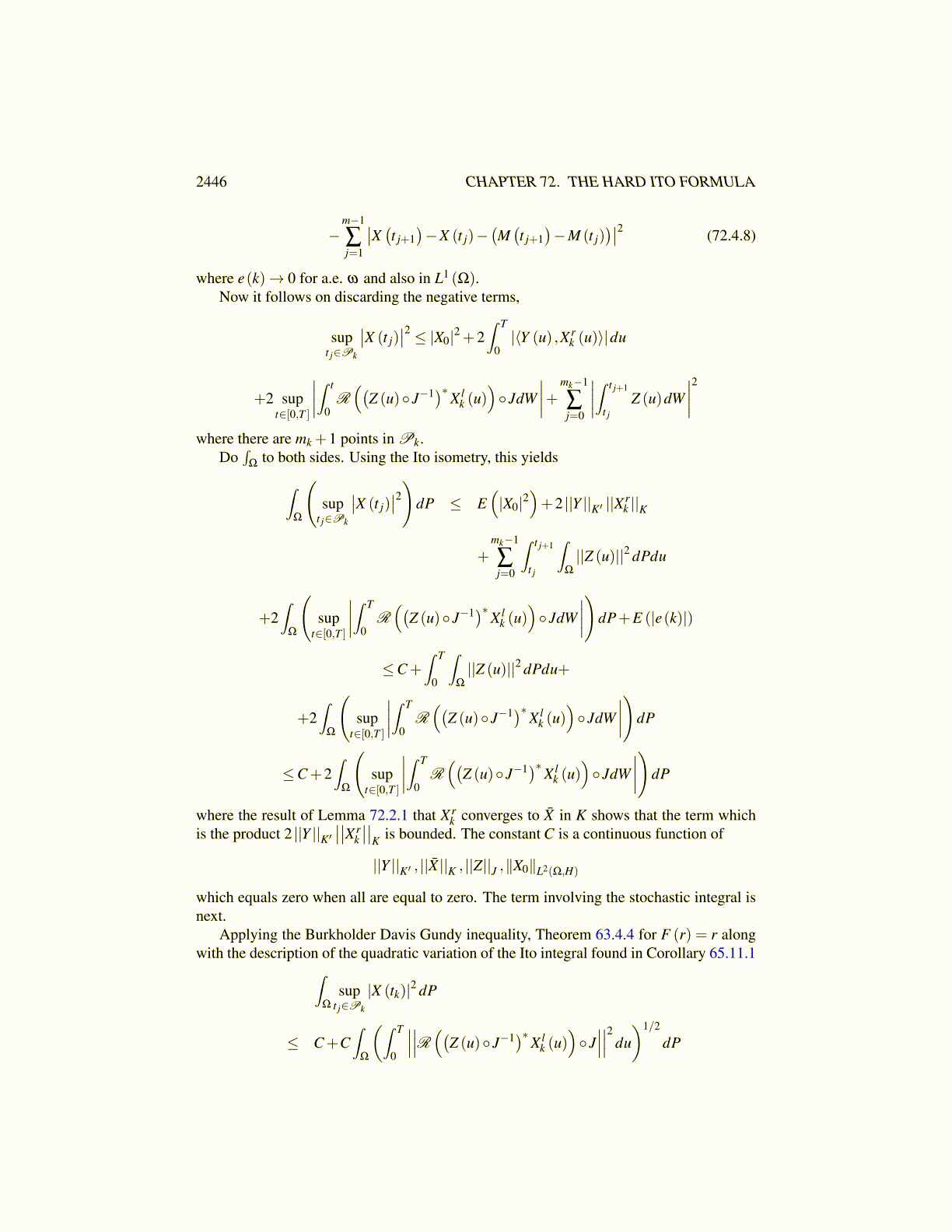
2446 CHAPTER 72. THE HARD ITO FORMULA
Proof: Consider the formula in Lemma 72.3.3.
|X (t)|2 = |X (s)|2 +2∫ t
s⟨Y (u) ,X (t)⟩du+2(X (s) ,M (t)−M (s))
+ |M (t)−M (s)|2−|X (t)−X (s)− (M (t)−M (s))|2 (72.4.6)
Now let t j denote a point of Pk from Lemma 72.2.1. Then for t j > 0,X (tk) is just the valueof X at tk but when t = 0, the definition of X (0) in this step function is X (0)≡ 0. Thus
|X (tm)|2−|X0|2 =m−1
∑j=1
∣∣X (t j+1)∣∣2− ∣∣X (t j)
∣∣2 + |X (t1)|2−|X0|2
Using the formula in Lemma 72.3.3, for t = tm this yields
|X (tm)|2−|X0|2 = 2m−1
∑j=1
∫ t j+1
t j
⟨Y (u) ,X rk (u)⟩du+
+2m−1
∑j=1
(∫ t j+1
t j
Z (u)dW,X (t j)
)H+
m−1
∑j=1
∣∣M (t j+1)−M (t j)
∣∣2−
m−1
∑j=1
∣∣X (t j+1)−X (t j)−
(M(t j+1
)−M (t j)
)∣∣2+2∫ t1
0⟨Y (u) ,X (t1)⟩du+2
(X0,∫ t1
0Z (u)dW
)+ |M (t1)|2
−|X (t1)−X0−M (t1)|2 (72.4.7)
Of course
2∫ t1
0⟨Y (u) ,X (t1)⟩du+2
(X0,∫ t1
0Z (u)dW
)+ |M (t1)|2
converges to 0 for a.e. ω as k→∞ because the norms of the partitions converge to 0 and thestochastic integral is continuous off a set of measure zero. Actually this is not completelyclear for the first of the above terms. This term is dominated by(∫ t1
0∥Y (u)∥p′ du
)1/p(∫ T
0∥X r
k (u)∥p du
)1/p
≤ C (ω)
(∫ t1
0∥Y (u)∥p′ du
)1/p
Hence this converges to 0 for a.e. ω . At this time, not much is known about the last term in72.4.7, but it is negative and is about to be neglected anyway.The Ito isometry implies theother two terms converge to 0 in L1 (Ω) also, in addition to converging for a.e. ω . At thistime, not much is known about the last term in 72.4.7, but it is negative and is about to beneglected anyway.