72.4. THE MAIN ESTIMATE 2445
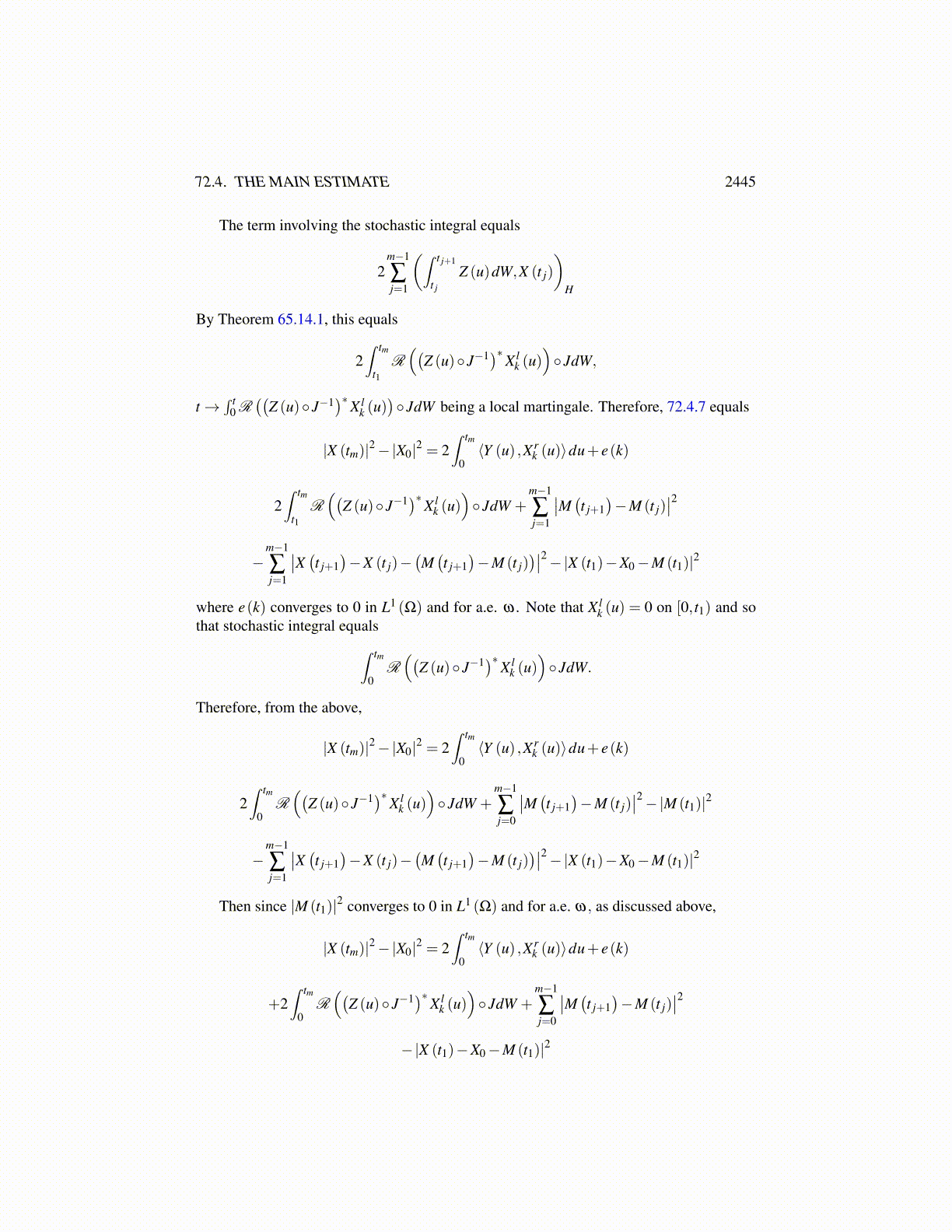
Comparing the ends of this string of equations,
|X (t)|2 = |X (s)|2 +2∫ t
s⟨Y (u) ,X (t)⟩du+2(X (s) ,M (t)−M (s))
+ |M (t)−M (s)|2−|X (t)−X (s)− (M (t)−M (s))|2
which is what was to be shown.Now it is time to prove the other assertion.
|M (t)|2−|X (t)−X0−M (t)|2 +2(X0,M (t))
=−|X (t)−X0|2 +2(X (t)−X0,M (t))+2(X0,M (t))
=−|X (t)−X0|2 +2(X (t) ,M (t))
= −|X (t)−X0|2 +2(X (t) ,X (t)−X0)−2⟨∫ t
0Y (s)ds,X (t)
⟩= |X (t)|2−|X0|2−2
⟨∫ t
0⟨Y (s) ,X (t)⟩ds
⟩Noting that X (0) = X0 ∈ L2 (Ω,H) and is F0 measurable, the first formula works in
both cases.
72.4 The Main EstimateThe following phenomenal estimate holds and it is this estimate which is the main idea inproving the Ito formula. The last assertion about continuity is like the well known resultthat if y ∈ Lp (0,T ;V ) and y′ ∈ Lp′ (0,T ;V ′) , then y is actually continuous with values inH. Later, this continuity result is strengthened further to give strong continuity.
Lemma 72.4.1 In the Situation 72.3.1,
E
(sup
t∈[0,T ]|X (t)|2H
)<C
(||Y ||K′ , ||X ||K , ||Z||J ,∥X0∥L2(Ω,H)
)< ∞.
where
J = L2([0,T ]×Ω;L2
(Q1/2U ;H
)),K ≡ Lp ([0,T ]×Ω;V ) ,
K′ ≡ Lp′ ([0,T ]×Ω;V ′).
Also, C is a continuous function of its arguments and C (0,0,0,0) = 0. Thus for a.e. ω,
supt∈[0,T ]
|X (t,ω)|H ≤C (ω)< ∞.
Also for a.e. ω, t→ X (t,ω) is weakly continuous with values in H.