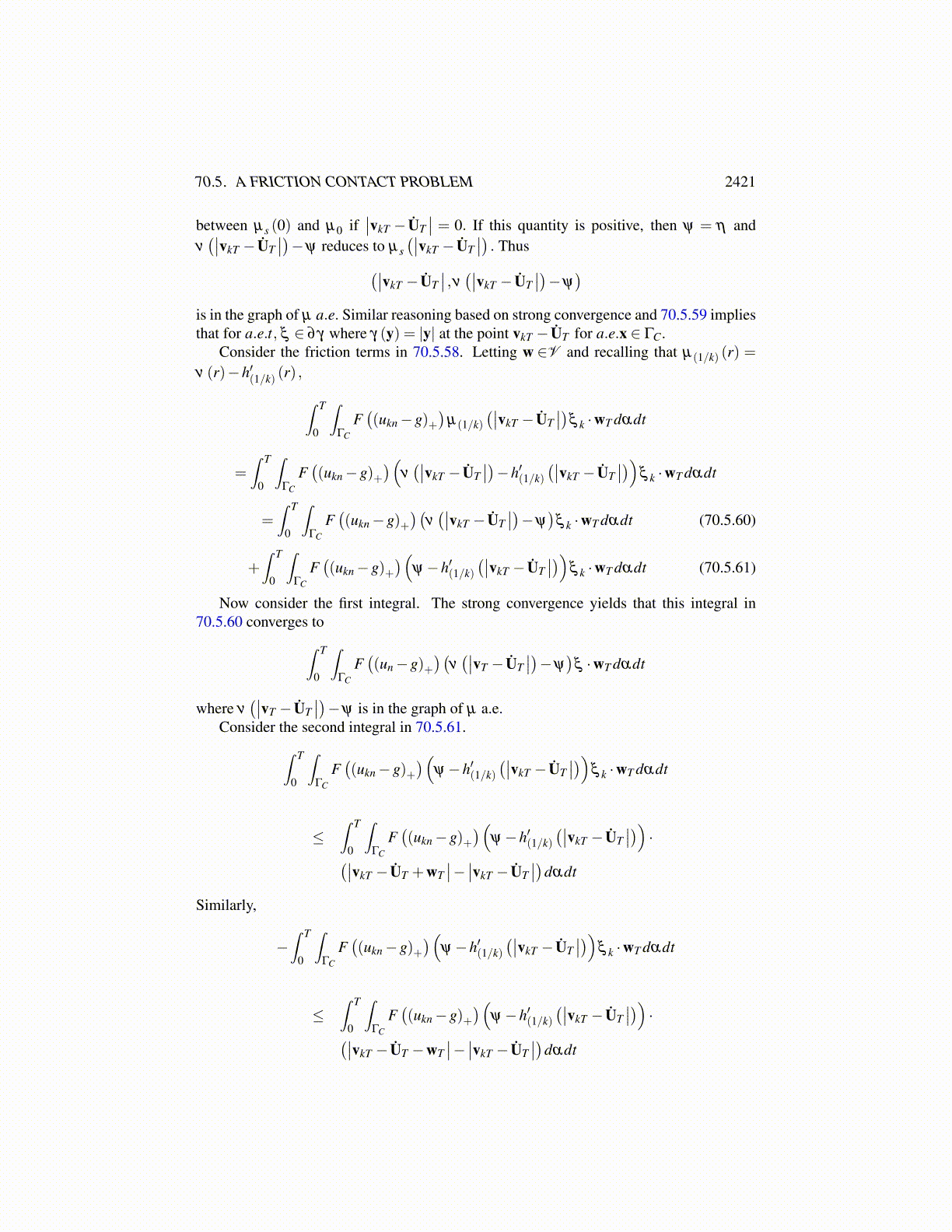
70.5. A FRICTION CONTACT PROBLEM 2421
∫ t
0γ∗T F((un−g(ω))+
)µ(∣∣vT − U̇T
∣∣)ξ ds =∫ t
0fds (70.5.57)
where ξ satisfies the inequality 70.5.56. In particular, v is continuous into V ′ and now,the conclusion of the measurable selection theorem applies and yields the existence of ameasurable solution to the integral equation just displayed for each ω . Taking a weakderivative, it follows that we have obtained a measurable solution to the system 70.5.33 -70.5.36.
In this case of Lipschitz µ one can show that the solution for each ω to the above in-tegral equation is unique although this it is not an obvious theorem. This follows standardprocedures involving Gronwall’s inequality and estimates. Therefore, it is possible to ob-tain the measurability using more elementary methods. In addition, it becomes possible toinclude a stochastic integral of the form
∫ t0 ΦdW. In this case one must consider a filtration
and obtain solutions which are adapted to the filtration. In the next section we considerthe case of discontinuous friction coefficient and in this case it is not clear whether there isuniqueness but we have still obtained a measurable solution.
70.5.3 Discontinuous coefficient of friction
In this section we consider the case where the coefficient of friction is a discontinuousfunction of the slip speed. This is the case described in elementary physics courses whichstate that the coefficient of sliding friction is less than the coefficient of static friction.Specifically, we assume the function µ, has a jump discontinuity at 0, becoming smallerwhen the speed is positive.
µ0
µs
νµs(0)
η = (µ0−µs(0))/2
Fig. 2. The graph of µ vs. the slip rate |v∗|, and ν .
We assume the function µs of the picture is Lipschitz continuous and decreasing just asshown. The new function ν is extended for r < 0 as shown and is just µs (r)+η for r > 0.
Lethε (r)≡
(η
2r2 + ε)1/2
µε (r) = ν (r)−h′ε (r)
Thus µε is bounded, Lipschitz continuous and as ε→ 0,µε (r)→ µ (r) for r > 0. Thus,