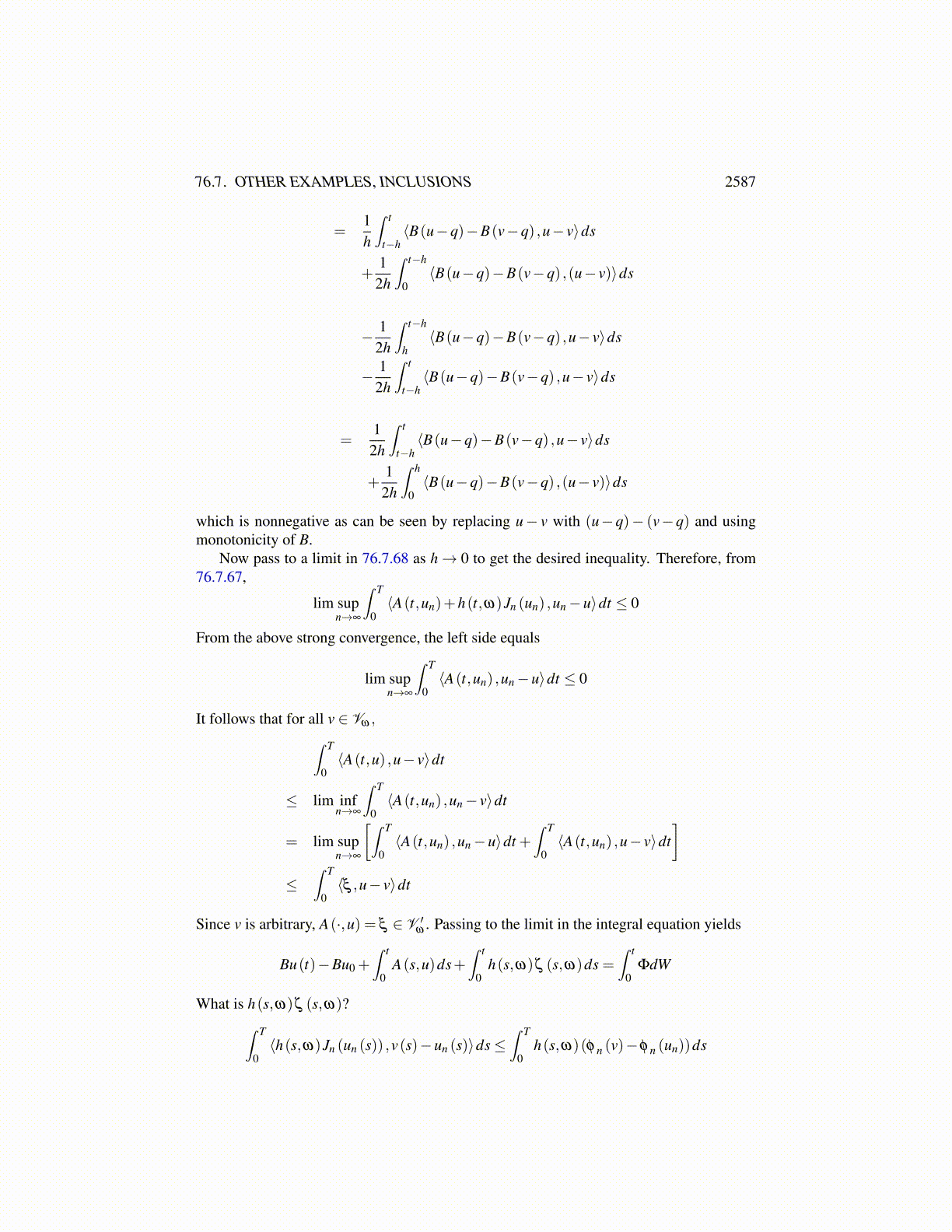
76.7. OTHER EXAMPLES, INCLUSIONS 2587
It follows from 76.7.64 that for all ω /∈ N and adjusting the constant,
⟨Bun (t) ,un (t)⟩+∫ T
0∥un∥p
V ds≤C (ω) (76.7.65)
for all n, where C (ω) depends only on ω .For ω /∈ N, the above estimate implies there exists a further subsequence, still called n
such thatBun→ Bu weak ∗ in L∞
(0,T,W ′
)un→ u weak ∗ in L∞ (0,T,H)
un→ u weakly in Vω
From the integral equation solved and the assumption that A is bounded, it can also beassumed that(
B(
un−∫ (·)
0ΨdW
))′→(
B(
u−∫ (·)
0ΨdW
))′weakly in V ′ω (76.7.66)
Bu(0) = Bu0
Aun→ ξ weakly in V ′ω
It is known that un is bounded in Vω . Also it is known that(
B(
un−∫ (·)
0 ΨdW))′
is
bounded in V ′ω . Therefore, B(
un−∫ (·)
0 ΨdW)
satisfies a Holder condition into V ′. Since Ψ
is in L∞,∫ (·)
0 ΨdW satisfies a Holder condition, and so Bun satisfies a Holder condition intoV ′ while Bun is bounded in W ′
ω . By compactness of the embedding of V into W, it followsthat W ′ embeds compactly into V ′. This is sufficient to conclude that {Bun} is precompactin W ′
ω . The proof is similar to one given by Lions. [91] page 57. See Theorem 69.5.6.Since B is the Riesz map, this implies that {un} is precompact in Wω and hence in Hω .
Therefore, one can take a further subsequence and conclude that
un→ u strongly in Hω ≡ L2 ([0,T ] ,L2 (U))
Therefore, a further subsequence, still denoted by n satisfies
un (t)→ u(t) in L2 (U) for a.e. t
We can also assume that
Jn (un)→ ζ weak ∗ in L∞ (0,T,L∞ (U))
From the integral equation solved,⟨(B(
un−∫ (·)
0ΨdW
))′,un−u
⟩Vω
+⟨A(t,un)+h(t,ω)Jn (un) ,un−u⟩= 0 (76.7.67)