2574 CHAPTER 76. IMPLICIT STOCHASTIC EQUATIONS
and (t,u,ω)→ A(t,u,ω) is progressively measurable. Also suppose for p ≥ 2, the coer-civity, and the boundedness conditions
λ ⟨Bu,u⟩+ ⟨A(t,u,ω) ,u⟩V ≥ δ ∥u∥pV − c(t,ω) (76.5.57)
for all λ large enough.
∥A(t,u,ω)∥V ′ ≤ k∥u∥p−1V + c1/p′ (t,ω) (76.5.58)
where c ∈ L1 ([0,T ]×Ω). Also suppose the monotonicity condition that for all r > 0 thereexists λ such that
⟨(λB+A(ω))(u)− (λB+A(ω))(v) ,u− v⟩ ≥ r∥u− v∥2W
Also suppose that
(t,u,ω) ∈ [0,T ]×W ×Ω→ σ (t,u,ω) is progressively measurable into W
∥σ (t,u,ω)∥W ≤C+C∥u∥W∥σ (t,u,ω)−σ (t, û,ω)∥L2(Q1/2U,W) ≤ K ∥u− û∥W
Then if u0 ∈ L2 (Ω,W ) with u0 F0 measurable, there exists a unique solution u(·,ω) ∈ Vω
with u ∈ V (Lp ([0,T ]×Ω,V ) and progressively measurable) such that for ω off a set ofmeasure zero,
Bu(t,ω)−Bu0 (ω)+∫ t
0A(s,u(s,ω) ,ω)ds =
∫ t
0f ds+B
∫ t
0σ (u)dW.
In case B is the Riesz map, you do not have to make any assumption on the size of K.Thus
⟨Bu,u⟩= ∥u∥2W
The case of most interest is the usual one where V ⊆W =W ′ ⊆ V ′, the case of a Gelfandtriple in which B is the identity. As to σ , the assumption is made that
∥σ (t,ω,u)∥W ≤C+C∥u∥W
∥σ (t,ω,u1)−σ (t,ω,u2)∥L2(Q1/2U,W) ≤ K ∥u1−u2∥WOf course it is also assumed that whenever u has values in W and is progressively measur-able, (t,ω)→ σ (t,ω,u(t,ω)) is also progressively measurable into L2
(Q1/2U,W
).
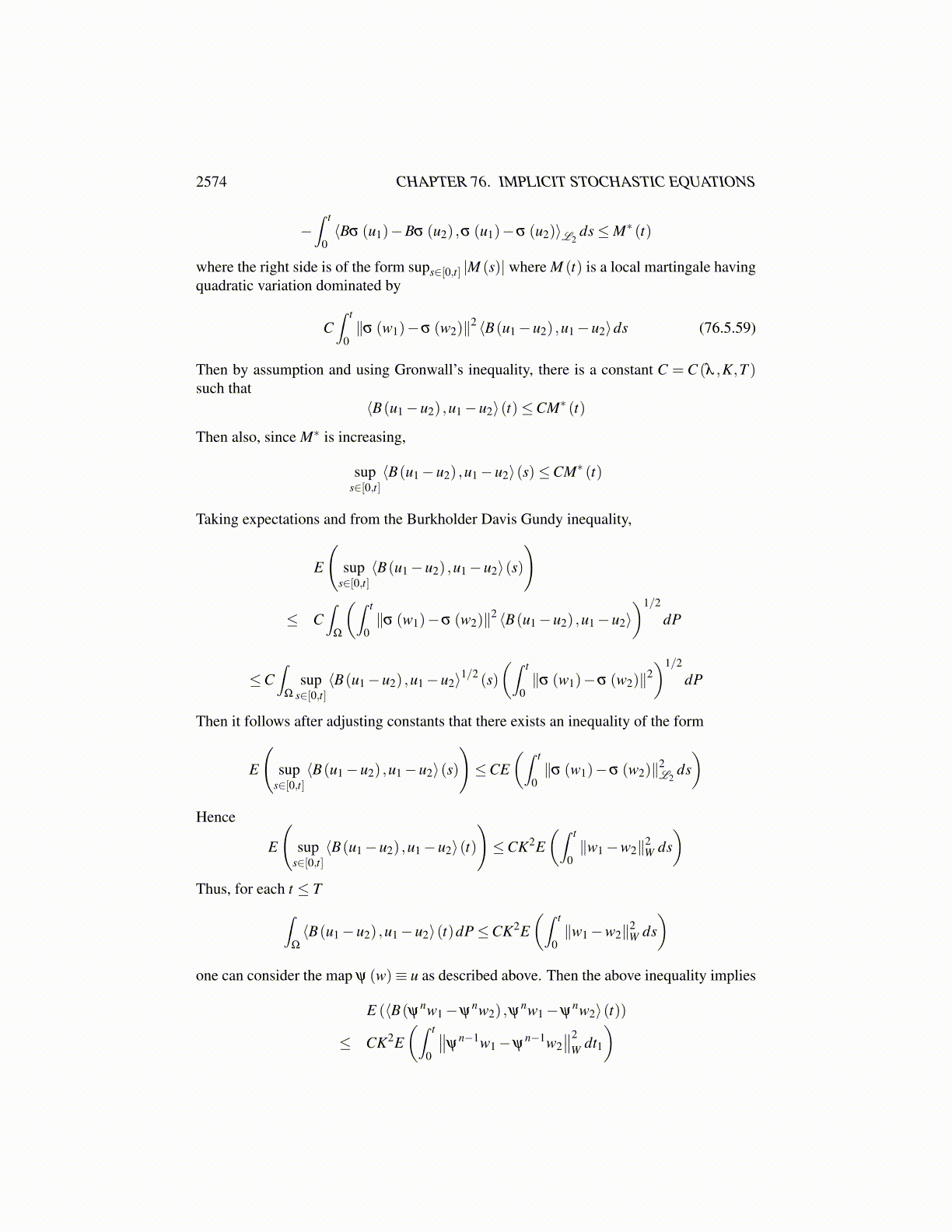
Letting wi ∈ L2 ([0,T ]×Ω,W ) each wi being progressively measurable, the above as-sumptions imply that there exists a solution ui to the integral equation
Bui (t,ω)−Bu0 (ω)+∫ t
0A(ui)ds =
∫ t
0f (s,ω)ds+B
∫ t
0σ (wi)dW
here we write σ (wi) for short instead of σ (t,ω,wi). First, consider
w ∈ L2 ([0,T ]×Ω,W )∩L∞([0,T ] ,L2 (Ω,W )
)