76.5. REPLACING Φ WITH σ (u) 2573

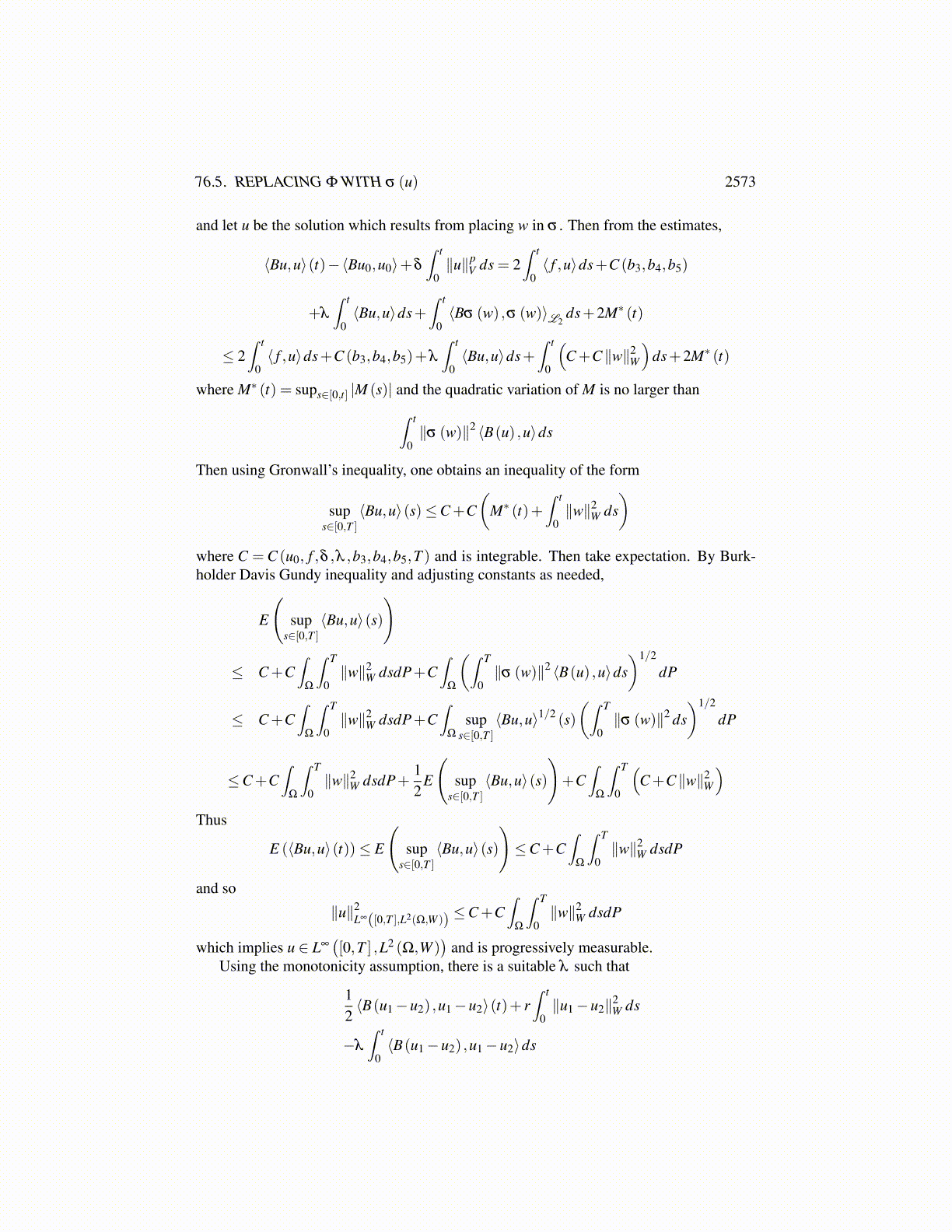
 ∫Ω

sups∈[0,t] ⟨B(u1−u2) ,u1−u2⟩1/2 ·

2ĈeλT(∫ t

0 K2 ∥w1−w2∥2W dt

)1/2dP



≤ E

(12

sups∈[0,t]

⟨B(u1−u2) ,u1−u2⟩(s)

)

+ĈeλT E(∫ t

0K2 ∥w1−w2∥2

W dt)

It follows that, after adjusting constants as needed, one gets an inequality of the followingform.

12

E

(sup

s∈[0,t]⟨B(u1−u2) ,u1−u2⟩(s)

)+4

∫Ω

∫ t

0∥u1−u2∥2

W dsdP

≤ ĈeλT E(∫ t

0K2 ∥w1−w2∥2

W dt)

This holds for every t ≤ T and so, from the estimate on the size of T, it follows that∫ T

0

∫Ω

∥u1−u2∥2W dsdP≤ 3

4

∫ T

0

∫Ω

∥w1−w2∥2W dtdP

Therefore, there is a unique fixed point to this mapping which takes w∈W to u the solutionto the integral equation. We denote it as u. Thus u is progressively measurable and for ω

off a set of measure zero, we have a solution to the integral equation

Bu(t,ω)−Bu0 (ω)+∫ t

0A(s,u(s,ω) ,ω)ds

=∫ t

0f ds+B

∫ t

0σ (u)dW, t ∈ [0,T ]

Now the same argument can be repeated for the succession of intervals mentioned above.However, you need to be careful that at T, you have Bu(T,ω) = B(u(T,ω)) for ω off aset of measure zero. If this is not so, you locate T ′ close to T for which it is so as inLemma 73.3.1 and use this T ′ instead, but these are mainly technical issues. This provesthe following existence and uniqueness theorem.

Theorem 76.5.1 Suppose f ∈ V ′ is progressively measurable and that

(t,ω)→ σ (t,ω,u(t,ω))

is progressively measurable whenever u is. Suppose that

λB+A(ω) : Vω → V ′ω , λB+A : V → V ′

are monotone hemicontinuous and bounded where

A(ω)u(t)≡ A(t,u(t) ,ω)

76.5. REPLACING ® WITH o (u) 2573Jo SUP sei, (B (U1 — U2) ,u — va) V,A 1/2eT (J K2||w, —wy[2, dt) dP< E (; sup (B(u; —u2),uy -9)(0)se[0,z]t+CeT E (/ K? ||w, — walla0It follows that, after adjusting constants as needed, one gets an inequality of the followingform.se[0,2]t< CTE (/ K2 Iwi —walfa)0This holds for every t < T and so, from the estimate on the size of T, it follows that_T 3 T2 2uy —Uu dsdP <= | [ wi —w dtdP[ [i 1 —U2|lWw <7 / ||| 1— WallyTherefore, there is a unique fixed point to this mapping which takes w € W to u the solutionto the integral equation. We denote it as u. Thus u is progressively measurable and for @off a set of measure zero, we have a solution to the integral equation1 t3F ( sup (B (uy — U2) , uy, — U2) «) +4] | ||oy —ug|\qy dsdPBu( 1,00) ~Buo(@) + [A(s,u(s,00) ,0)ds= [ fase [ owaw.t € [0,7]Jo J0Now the same argument can be repeated for the succession of intervals mentioned above.However, you need to be careful that at T, you have Bu(T,@) = B(u(T,@)) for @ off aset of measure zero. If this is not so, you locate T’ close to T for which it is so as inLemma 73.3.1 and use this 7’ instead, but these are mainly technical issues. This provesthe following existence and uniqueness theorem.Theorem 76.5.1 Suppose f € V' is progressively measurable and that(t,@) > o(t,@,u(t,@))is progressively measurable whenever u is. Suppose thatAB+A(Q): Vg + Vi, AB+A:V —V'are monotone hemicontinuous and bounded whereA(@)u(t) =A(t,u(t),@)