2564 CHAPTER 76. IMPLICIT STOCHASTIC EQUATIONS
=∞
∑i=1|⟨Bu(t) ,ei⟩|2 = ⟨Bu(t) ,u(t)⟩ (76.4.42)
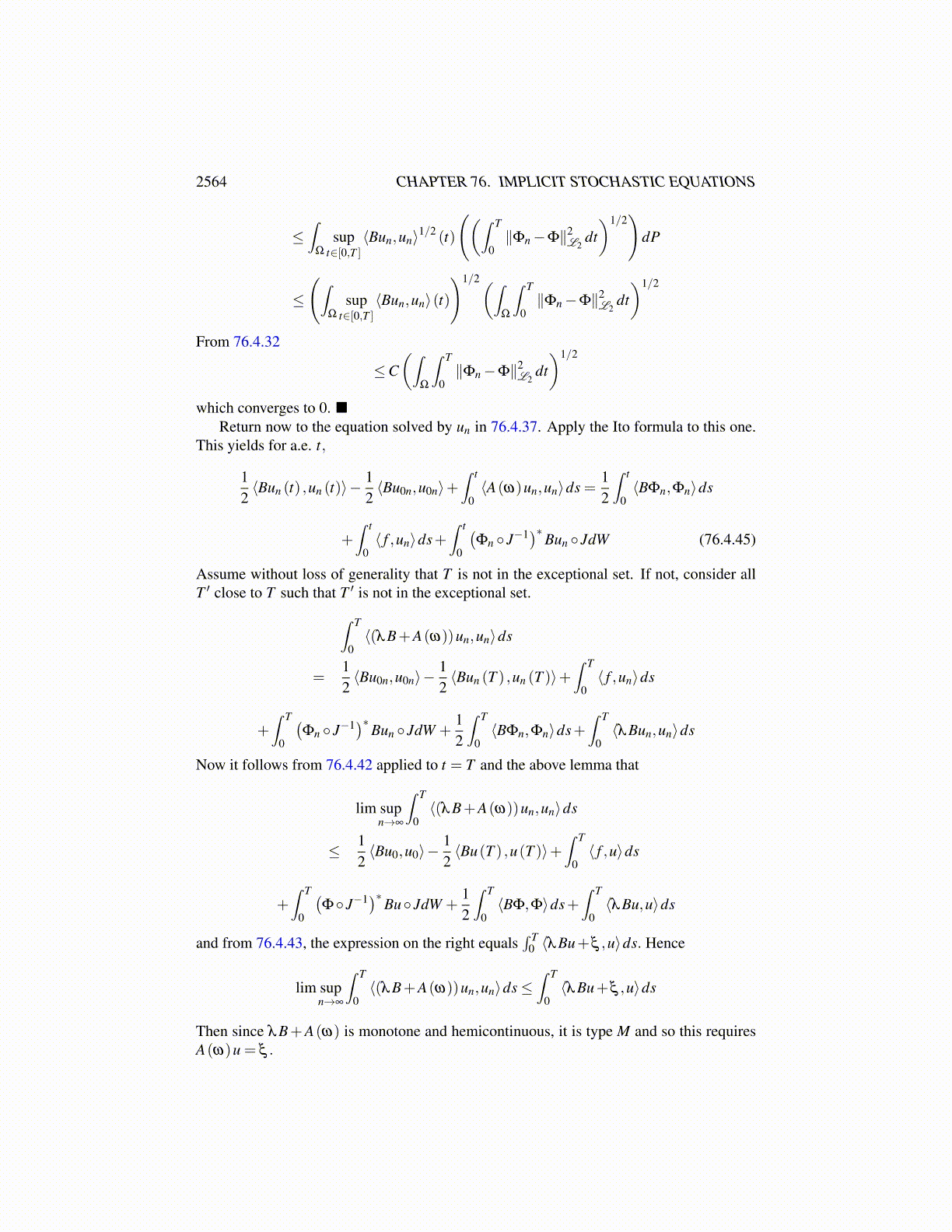
Thus the above inequalities and formulas hold for a.e. t.Return to the equation 76.4.41. Define the stopping time
τ p ≡ inf{
t ∈ [0,T ] : ⟨Bu,u⟩(t)+∫ t
0∥ξ∥p′
V ′ ds > p}
From 76.4.28 and the fact that ξ ∈ V ′ω , it follows that τ p = ∞ for all p large enough. Thenstop the equation using this stopping time.
Buτ p (t,ω)−Bu0 (ω)+∫ t
0X[0,τ p]ξ
τ p (s,ω)ds
=∫ t
0X[0,τ p] f (s,ω)ds+B
∫ t
0X[0,τ p]ΦdW
From the implicit Ito formula Theorem 76.2.3, for a.e. t,
12⟨Buτ p (t) ,uτ p (t)⟩− 1
2⟨Bu0,u0⟩+
∫ t
0X[0,τ p]
⟨ξ
τ p ,uτ p⟩
ds
=12
∫ t
0X[0,τ p] ⟨BΦ,Φ⟩ds
+∫ t
0X[0,τ p] ⟨ f ,u
τ p⟩ds+∫ t
0X[0,τ p]
(Φ◦ J−1)∗Buτ p ◦ JdW
Then letting p→ ∞ this yields the following formula for a.e. t
12⟨Bu(t) ,u(t)⟩− 1
2⟨Bu0,u0⟩+
∫ t
0⟨λBu+ξ ,u⟩ds =
12
∫ t
0⟨BΦ,Φ⟩ds
+∫ t
0⟨ f ,u⟩ds+
∫ t
0
(Φ◦ J−1)∗Bu◦ JdW +
∫ t
0⟨λBu,u⟩ds (76.4.43)
Lemma 76.4.5 It is true that
limn→∞
∫ T
0⟨Bun,un⟩dt =
∫ T
0⟨Bu,u⟩dt
Proof: From 76.4.28 Bun → z strongly in C(NC
ω ,W′) . But also, for each t,Bun (t)→
Bu(t) weakly in V ′ and so z(t) = Bu(t) . This strong convergence in C(NC
ω ,W′) along with
the uniform norm with the weak convergence of un to u in Vω is sufficient to obtain theabove limit.
You might think that∫ T
0
(Φn ◦ J−1)∗Bun ◦ JdW →
∫ T
0
(Φ◦ J−1)∗Bu◦ JdW
but this is not entirely clear. It will be true in the case that in 76.4.26, α = 2 and U = Wand this is shown later. However, it is not clearly true here unless it is also the case thatΦ ∈ L2
(Ω,L∞
([0,T ] ,L2
(Q1/2U,W
))).