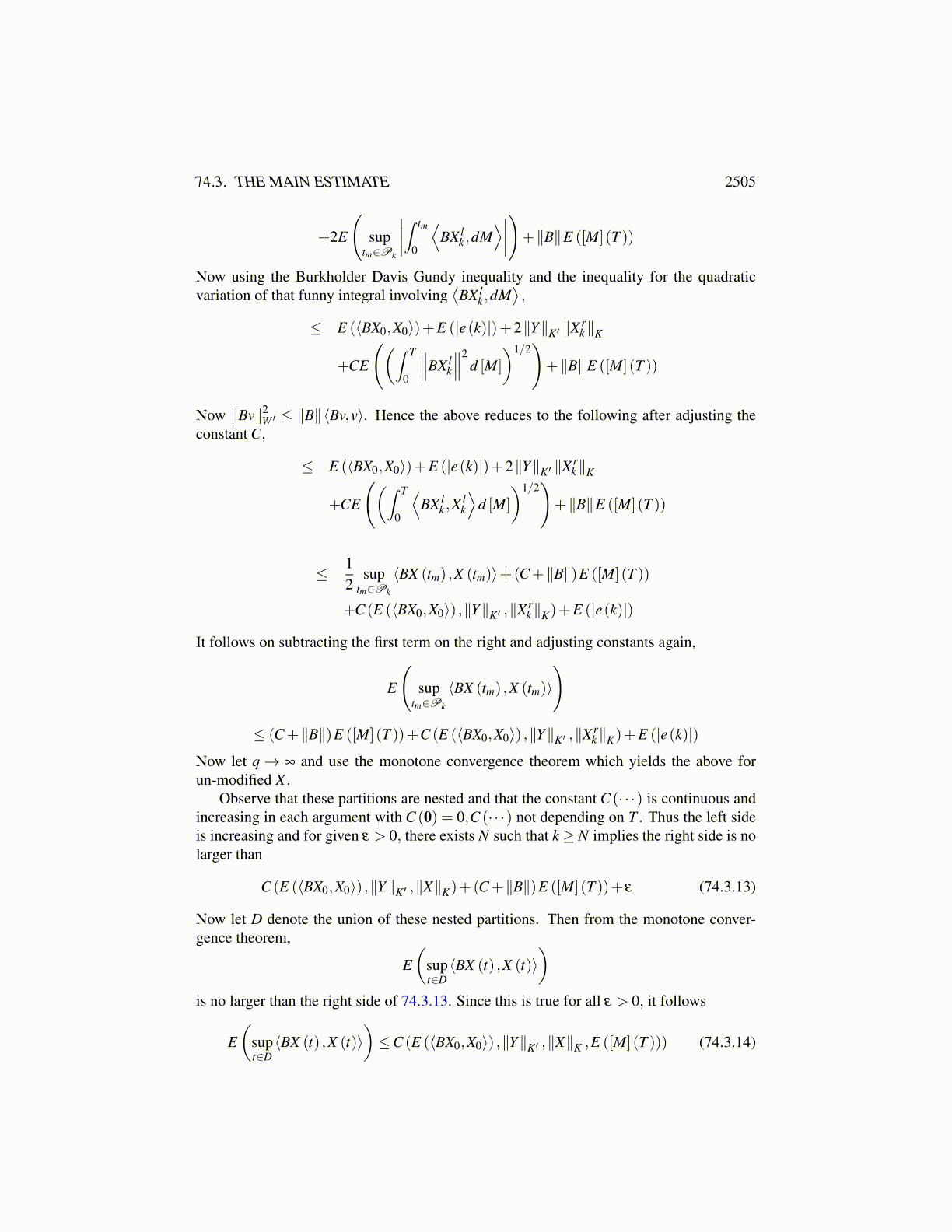
74.3. THE MAIN ESTIMATE 2505
Recall it was assumed that ∥B(ω)∥ is bounded. This is where it is convenient to make thisassumption. Consider the first term. This term is dominated by(∫ t1
0∥Y (u)∥p′ du
)1/p′(∫ T
0∥X r
k (u)∥p du
)1/p
≤ C (ω)
(∫ t1
0∥Y (u)∥p′ du
)1/p′
,
(∫Ω
C (ω)p dP)1/p
< ∞
Hence this converges to 0 for a.e. ω and also converges to 0 in L1 (Ω).At this time, not much is known about the last term in 74.3.10, but it is negative and is
about to be neglected anyway.The second term on the right equals
2∫ tm
t1
⟨BX l
k ,dM⟩= 2
∫ tm
0
⟨BX l
k ,dM⟩+ e(k)
where e(k)→ 0 for a.e. ω and in L1 (Ω). Also note that since ⟨BM (t1) ,M (t1)⟩ convergesto 0 in L1 (Ω) and for a.e. ω, the sum involving⟨
B(M(t j+1
)−M (t j)
),M(t j+1
)−M (t j)
⟩can be started at 0 rather than 1 at the expense of adding in a term which converges to 0a.e. and in L1 (Ω). Thus 74.3.10 is of the form
⟨BX (tm) ,X (tm)⟩−⟨BX0,X0⟩= e(k)+2∫ tm
0⟨Y (u) ,X r
k (u)⟩du+
+2∫ tm
0
⟨BX l
k ,dM⟩
+m−1
∑j=0
⟨B(M(t j+1
)−M (t j)
),M(t j+1
)−M (t j)
⟩
−m−1
∑j=1
⟨B(X(t j+1
)−X (t j)−
(M(t j+1
)−M (t j)
)),
X(t j+1
)−X (t j)−
(M(t j+1
)−M (t j)
)⟩−⟨B(X (t1)−X0−M (t1)) ,X (t1)−X0−M (t1)⟩ (74.3.11)
where e(k)→ 0 for a.e. ω and also in L1 (Ω).Now it follows, on discarding the negative terms,
⟨BX (tm) ,X (tm)⟩−⟨BX0,X0⟩ ≤ e(k)+2∫ tm
0⟨Y (u) ,X r
k (u)⟩du+
+2∫ tm
0
⟨BX l
k ,dM⟩+
m−1
∑j=0
⟨B(M(t j+1
)−M (t j)
),M(t j+1
)−M (t j)
⟩