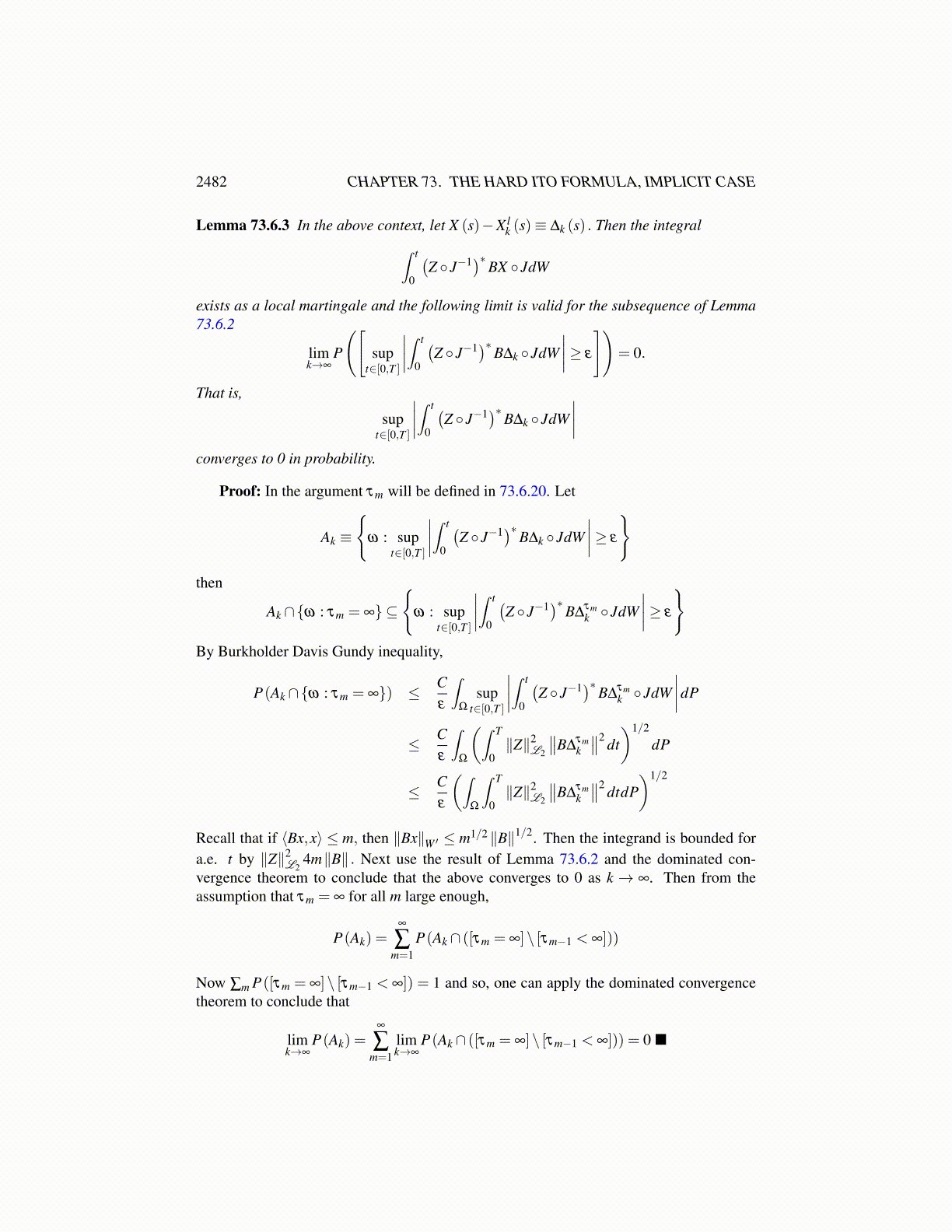
2482 CHAPTER 73. THE HARD ITO FORMULA, IMPLICIT CASE
Then from the assumption that τ p = ∞ for all p large enough, it follows that
A = ∪∞m=1A∩ ([τm = ∞]\ [τm−1 < ∞])
Now
P(A∩ [τm = ∞])≤ P(
ω :∫ T
0X[0,τm]
∣∣∣(Z ◦ J−1)∗BX ◦ J∣∣∣2 dt = ∞
)(73.6.21)
Consider the integrand. What is the meaning of∣∣(Z ◦ J−1
)∗BX ◦ J∣∣2? You have
(Z ◦ J−1)∗ ∈L2
(W ′,J
(Q1/2U
)′)while BX ∈W ′ and so
(Z ◦ J−1
)∗BX ∈L2
(J(Q1/2U
)′,R)
which is just(J(Q1/2U
))′.
Thus(Z ◦ J−1
)∗BX ◦ J would be in(Q1/2U
)′and to get the L2 norm, you would take an
orthonormal basis in Q1/2U denoted as {gi} and the square of this norm is just
∑i
[((Z ◦ J−1)∗BX ◦ J
)(gi)]2≡ ∑
i
[(Z ◦ J−1)∗BX (Jgi)
]2
≡ ∑i
[BX(Z ◦ J−1 (Jgi)
)]2= ∑
i[(BX)(Zgi)]
2
≤ ∑i∥BX∥2 ∥Zgi∥2
W
Now incorporating the stopping time, you know that for a.e. t,
⟨BX ,X⟩(t) = ⟨BX (t) ,X (t)⟩ ≤ m
and so ∥BX (t)∥can be estimated in terms of m as follows.
|⟨B(X (t)) ,w⟩| ≤ ⟨B(X (t)) ,X (t)⟩1/2 ∥B∥1/2 ∥w∥W
=
(∑
i⟨BX (t) ,ei⟩2V ′,V
)1/2
∥B∥1/2 ∥w∥W
≤√
m∥B∥1/2 ∥w∥W , so ∥BX (t)∥ ≤ m∥B∥1/2
Thus the integrand satisfies for a.e. t
X[0,τm]
∣∣∣(Z ◦ J−1)∗BX ◦ J∣∣∣2 ≤ m∥B∥∥Z∥2
L2
Hence, from 73.6.21, P(A∩ [τm = ∞])
≤ P(
ω :∫ T
0∥Z∥2
L2m∥B∥dt = ∞
)