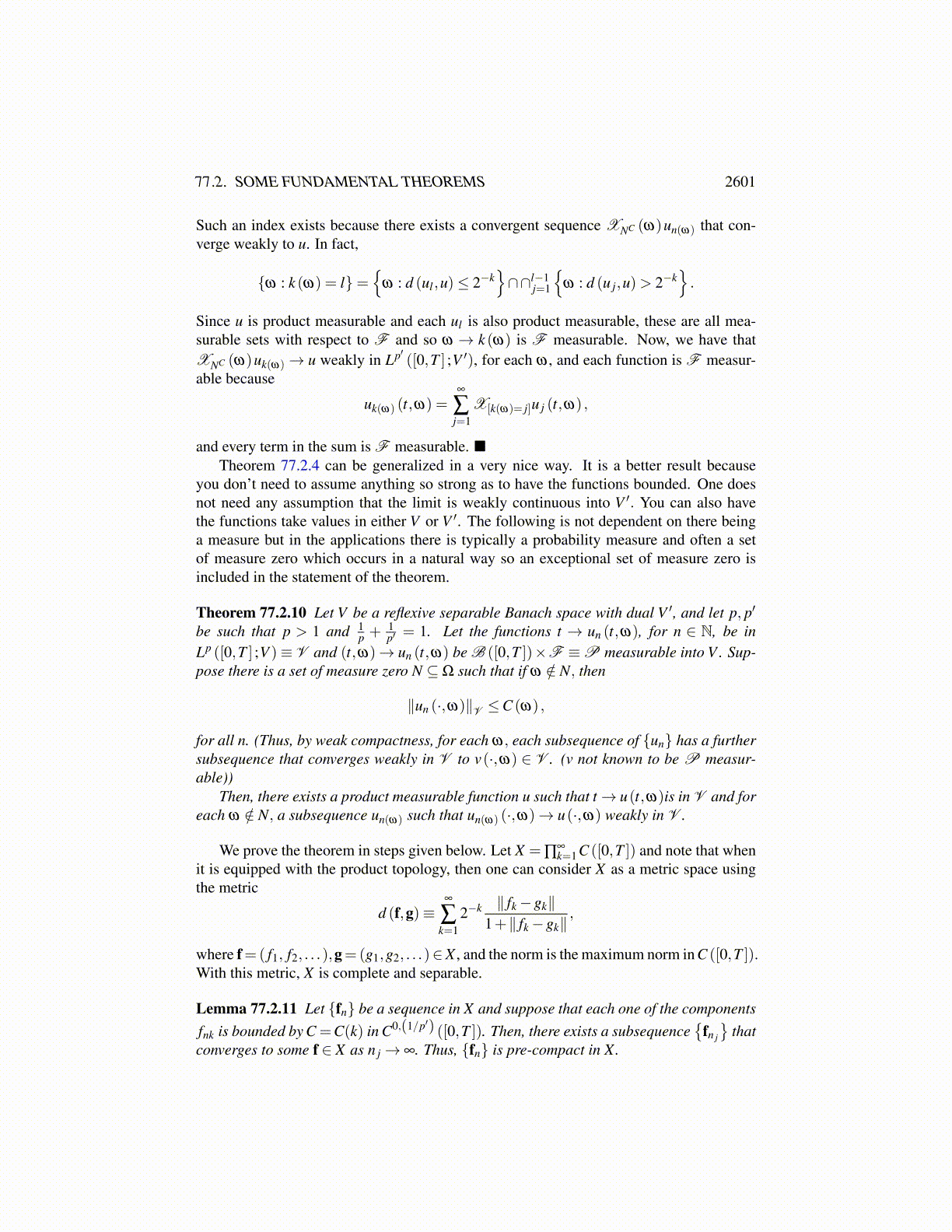
77.2. SOME FUNDAMENTAL THEOREMS 2601
Proof: From the definition of Γ(ω) = ∩∞n=1Γn (ω) it follows that ω → Γ(ω) is a com-
pact set-valued map in X and is nonempty because each Γn (ω) is nonempty and compact,and the Γn (ω) are nested. We next show that ω → Γ(ω) is F measurable. Indeed, eachΓn is compact valued and F measurable so, if F is closed,
Γ(ω)∩F = ∩∞n=1Γ
n (ω)∩F,
and the left-hand side is not empty if and only if each Γn (ω)∩F ̸= /0. Thus, for F closed,
{ω : Γ(ω)∩F ̸= /0}= ∩n {ω : Γn (ω)∩F ̸= /0} ,
and soΓ− (F) = ∩nΓ
n− (F) ∈F .
The last claim follows from the theory of multi-functions, see, e.g., [10, 70] or Section 48.See Proposition 48.1.4. The fact that Γn (ω) is compact, Γn is measurable and Γn− (U) ∈F , for U open, imply the strong measurability of Γn [10, 70] see also Section 48, andalso that Γn− (F) ∈ F . Thus, ω → Γ(ω) is a nonempty compact valued in X and Fmeasurable. We are using the theorem which says that when Γ has compact values, thenone can conclude that strong measurability and measurability coincide. This is why we cansay that Γn− (F) ∈F .
The standard theory [10, 70], Section 48, also guarantees the existence of an F mea-surable selection ω → γ (ω) with γ (ω) ∈ Γ(ω), for each ω , and also that t → γk (t,ω)(the kth component of γ) is continuous. Next, we consider the product measurability of γk.We know that ω → γk (ω) is F measurable into C ([0,T ]) and since pointwise evaluationis continuous, ω → γk (t,ω) is F measurable. (This is nothing more than a case of thegeneral result that a continuous function of a measurable function is measurable.) Then,since t→ γk (t,ω) is continuous, it follows that γk is a P measurable real valued functionand that γ is a P measurable R∞ valued function. Since γ (ω) ∈ Γ(ω) , it follows that foreach n,γ (ω) ∈ Γn (ω) . Therefore, there exists jn ≥ n such that for each ω ,
d (f(XNC (ω)u jn (·,ω)) ,γ (ω))< 2−n.
Therefore, for a suitable subsequence{
un(ω) (·,ω)}
, we have
γ (ω) = limn(ω)→∞
f(XNC (ω)un(ω) (·,ω)
),
for each ω . In particular, for each k
γk (t,ω) = limn(ω)→∞
f(XNC (ω)un(ω) (t,ω)
)k
= limn(ω)→∞
mk
∫ t
lmk (t)
⟨φ rk
,XNC (ω)un(ω) (s,ω)⟩
Vds, (77.2.3)
for each t.Note that it is not clear that (t,ω)→ f
(XNC (ω)un(ω) (t,ω)
)is P measurable, al-
though (t,ω)→ γ (t,ω) is P measurable.