2592 CHAPTER 76. IMPLICIT STOCHASTIC EQUATIONS
one end. Suppose for sake of illustration that the left end is clamped, u(0, t) = ux (0, t) = 0,while the right end which has the attached mass is free to move, ux (1, t) = 0, and the beamoccupies the interval [0,1] in material coordinates. Then the stress is σ =−uxxx and balanceof momentum is
utt = σ x + f
where f is a body force. Thus, letting
w ∈V ≡{
w ∈ H2 (0,1) : w(0) = wx (0) = 0,wx (1) = 0}
be a test function,∫ 1
0uttwdx = σw|10 +
∫ 1
0(−σ)wxdx+
∫ 1
0f wdx
= −mutt (1, t)w(1, t)+∫ 1
0uxxxwxdx+
∫ 1
0f wdx
Doing another integration by parts and using the boundary conditions, it follows that anappropriate variational formulation for this problem is∫ 1
0uttwdx+mγ1uttγ1w+
∫ 1
0uxxwxxdx =
∫ 1
0f wdx
where here γ1 is the trace map on the right end.Letting
u(t) = u0 +∫ t
0v(s)ds,
where u(0, t) = u0, we can write the above variational equation in the form
(Bv)′+Au = f , Bv(0) = Bv0
where we assume that v0 ∈W where W is the closure of V in H1 (0,1) and the operatorsare given by
B : W →W ′, ⟨Bu,w⟩ ≡∫ 1
0uwdx+mγ1uγ1w
A : V →V ′, ⟨Au,w⟩ ≡∫ 1
0uxxwxxdx
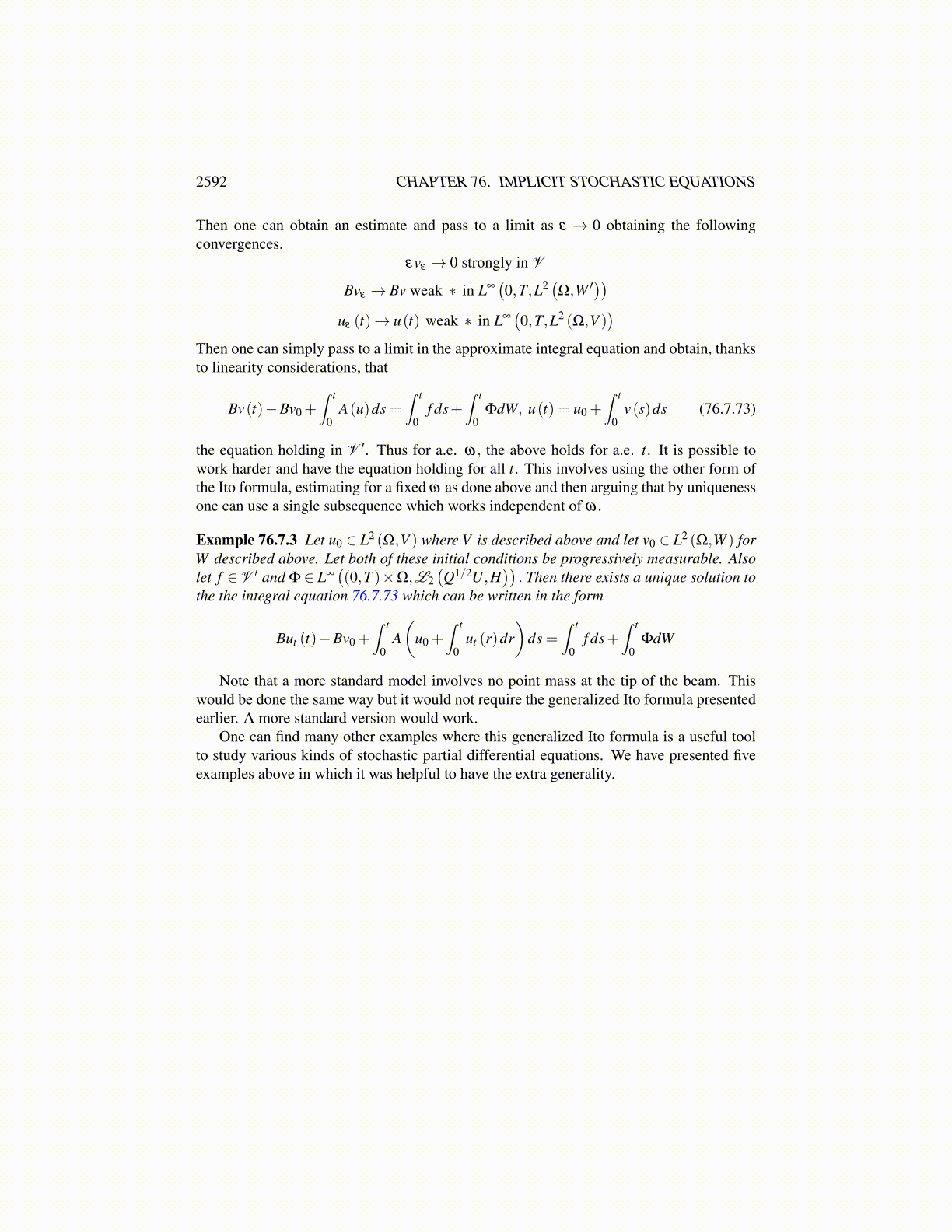
Thus in terms of an integral equation, this would be of the form
Bv(t)−Bv0 +∫ t
0A(u)ds =
∫ t
0f ds
This suggests a stochastic version of the form
Bv(t)−Bv0 +∫ t
0A(u)ds =
∫ t
0f ds+
∫ t
0ΦdW