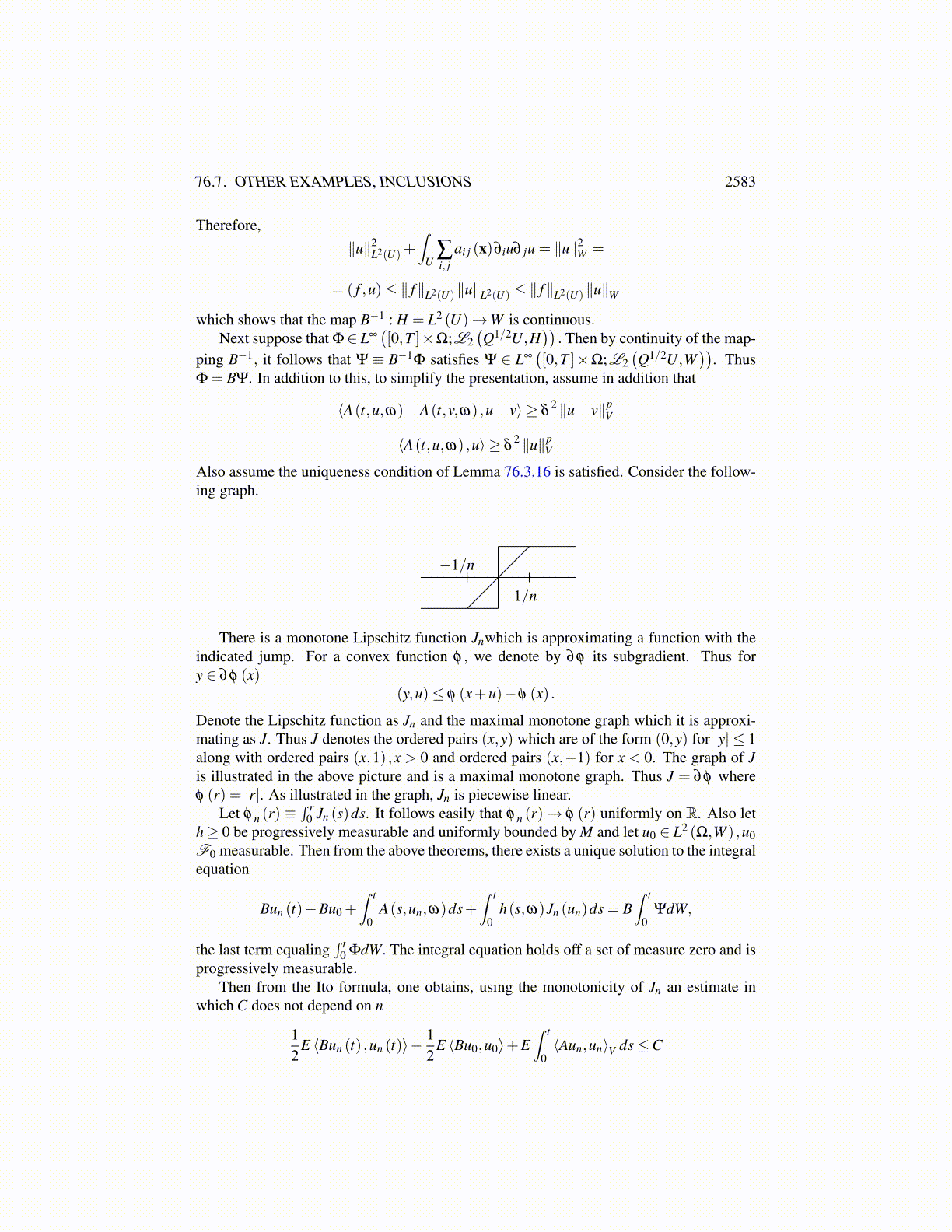
76.7. OTHER EXAMPLES, INCLUSIONS 2583
Also for some δ > 0⟨Au−Av,u− v⟩ ≥ δ ∥u− v∥p
V
The nonlinear operator is obviously monotone and hemicontinuous. As for u0, it is onlynecessary to assume u0 ∈ L2 (Ω,W ) and F0 measurable. Then Theorem 76.4.7 gives theexistence of a solution in the sense that for a.e. ω the integral equation holds for all t. Notethat b can be unbounded and may also vanish. Thus the equation can degenerate to the caseof a non stochastic nonlinear elliptic equation.
The existence theorems can easily be extended to include the situation where Φ isreplaced with a function of the unknown function u. This is done by splitting the timeinterval into small sub intervals of length h and retarding the function in the stochasticintegral, like a standard proof of the Peano existence theorem. Then the Ito formula isapplied to obtain estimates and a limit is taken.
Other examples of the usefulness of this theory will result when one considers stochas-tic versions of systems of partial differential equations in which there is a nonlinear cou-pling between a parabolic equation and a nonlinear elliptic equation. These kinds of prob-lems occur, for example as quasistatic damage problems in which the damage parametersatisfies a parabolic equation and the balance of momentum is a nonlinear elliptic equationand the two equations are coupled in a nonlinear way.
76.7 Other Examples, InclusionsThe above general result can also be used as a starting point for evolution inclusions orother situations where one does not have hemicontinuous operators. Assume here that
Φ ∈ L∞
([0,T ]×Ω,L2
(Q1/2U,H
)).
We will use the following simple observation. Let α > 2. Let ∥Φ∥∞
denote the norm inL∞([0,T ]×Ω,L2
(Q1/2U,H
)). By the Burkholder Davis Gundy inequality,∫
Ω
(∣∣∣∣∫ t
sΦdW
∣∣∣∣)α
dP≤
∫Ω
(sup
r∈[s,t]
∣∣∣∣∫ r
sΦdW
∣∣∣∣)α
dP≤C∫
Ω
(∫ t
s∥Φ∥2 dτ
)α/2
dP
≤C∥Φ∥α
∞
∫Ω
(∫ t
sdτ
)α/2
dP =C∥Φ∥α
∞|t− s|α/2
By the Kolmogorov Čentsov theorem, this shows that t →∫ t
0 ΦdW is Holder continuouswith exponent
γ <(α/2)−1
α=
12− 1
α
Since α > 2 is arbitrary, this shows that for any γ < 1/2, the stochastic integral is Holdercontinuous with exponent γ . This is exactly the same kind of continuity possessed by theWiener process. We state this as the following lemma.