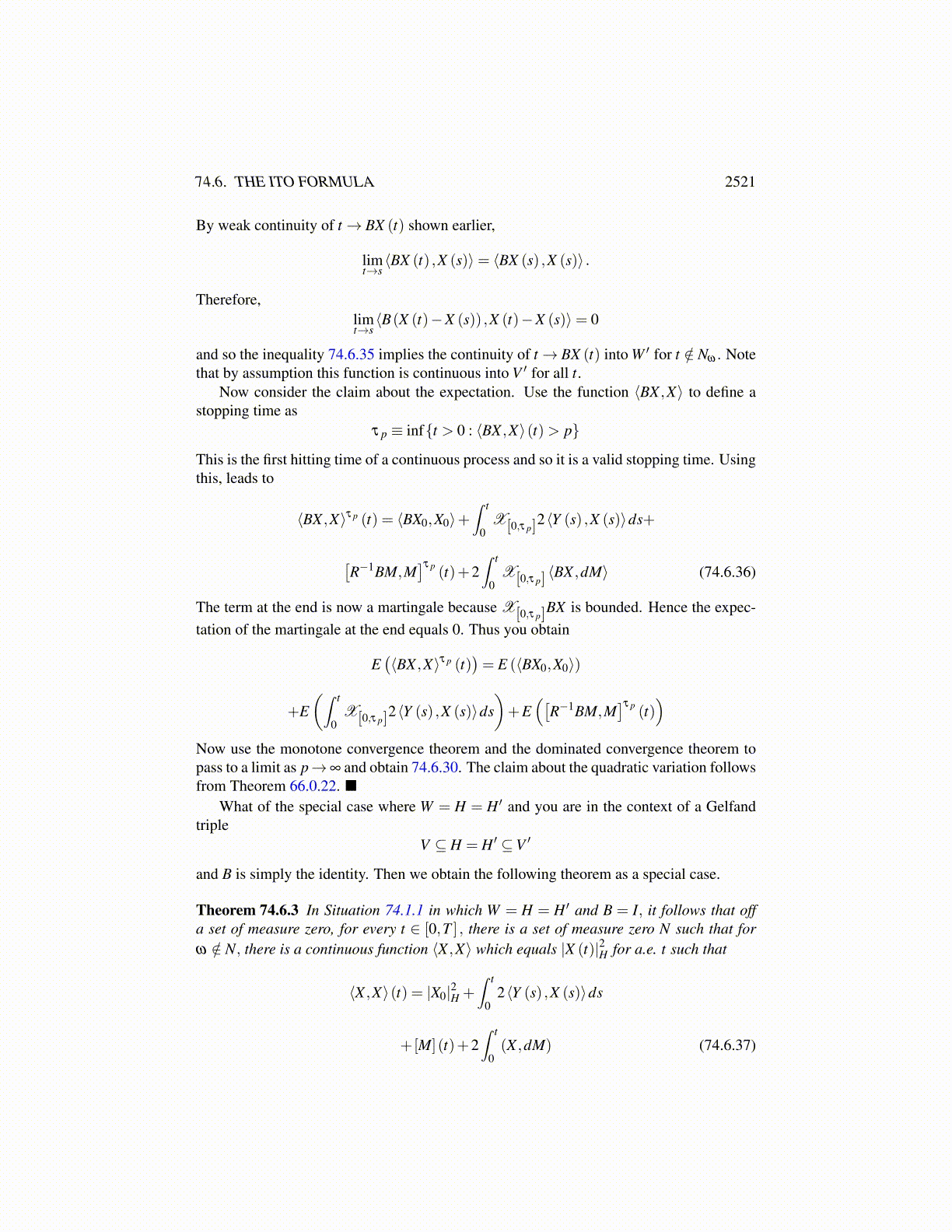
74.6. THE ITO FORMULA 2521
≤ 4 supt∈[0,T ]
∣∣∣∣∫ t
0
⟨B(
X−X lm
),dM
⟩∣∣∣∣In Lemma 74.5.2 the above expression converges to 0. It follows there is a set of measure0 including the earlier one such that for ω not in that set, 74.6.33 converges to 0 in R.Similar reasoning shows the first term on the right in the non stochastic integral of 74.6.32is dominated by an expression of the form
4∫ T
0
∣∣∣⟨Y (s) ,X (s)−X lm (s)
⟩∣∣∣ds
which clearly converges to 0 thanks to Lemma 74.5.1. Finally, it is obvious that
limm,k→∞
[R−1BM,M
](t (k))−
[R−1BM,M
](t (m)) = 0 for a.e. ω
due to the continuity of the quadratic variation.This shows that for ω off a set of measure 0
limm,k→∞
⟨B(X (t (k))−X (t (m))) ,X (t (k))−X (t (m))⟩= 0
Then for x ∈W,
|⟨B(X (t (k))−X (t (m))) ,x⟩|≤ ⟨B(X (t (k))−X (t (m))) ,X (t (k))−X (t (m))⟩1/2 ⟨Bx,x⟩1/2
≤ ⟨B(X (t (k))−X (t (m))) ,X (t (k))−X (t (m))⟩1/2 ∥B∥1/2 ∥x∥W
and solim
m,k→∞
∥BX (t (k))−BX (t (m))∥W ′ = 0
Recall t was arbitrary and {t (k)} is a sequence converging to t. Then the above has shownthat {BX (t (k))}∞
k=1 is a convergent sequence in W ′. Does it converge to BX (t)? Let ξ (t)∈W ′ be what it converges to. Letting v ∈ V then, since the integral equation shows thatt→ BX (t) is continuous into V ′,
⟨ξ (t) ,v⟩= limk→∞
⟨BX (t (k)) ,v⟩= ⟨BX (t) ,v⟩ ,
and now, since V is dense in W, this implies ξ (t) = BX (t) = B(X (t)) since t /∈ Nω . Recallalso that it was shown earlier that BX is weakly continuous into W ′ on [0,T ] hence thestrong convergence of {BX (t (k))}∞
k=1 in W ′ implies that it converges to BX (t), this for anyt ∈ NC
ω .For every t ∈ D and for ω off the exceptional set of measure zero described earlier,
⟨B(X (t)) ,X (t)⟩= ⟨BX0,X0⟩+∫ t
02⟨Y (s) ,X (s)⟩ds+
[R−1BM,M
](t)+2
∫ t
0⟨BX ,dM⟩ (74.6.34)