2502 CHAPTER 74. A MORE ATTRACTIVE VERSION
Proof: This follows from Lemma 66.0.20. This can be seen because, thanks to the fact
that BXlσ k
qk is bounded, the function BX l
k is in the set G described there. This is a placewhere we use that d [M] = kdt.
74.3 The Main EstimateThe argument will be based on a formula which follows in the next lemma.
Lemma 74.3.1 In Situation 74.1.1 the following formula holds for a.e. ω for 0 < s < t. Inthe following, ⟨·, ·⟩ denotes the duality pairing between V,V ′.
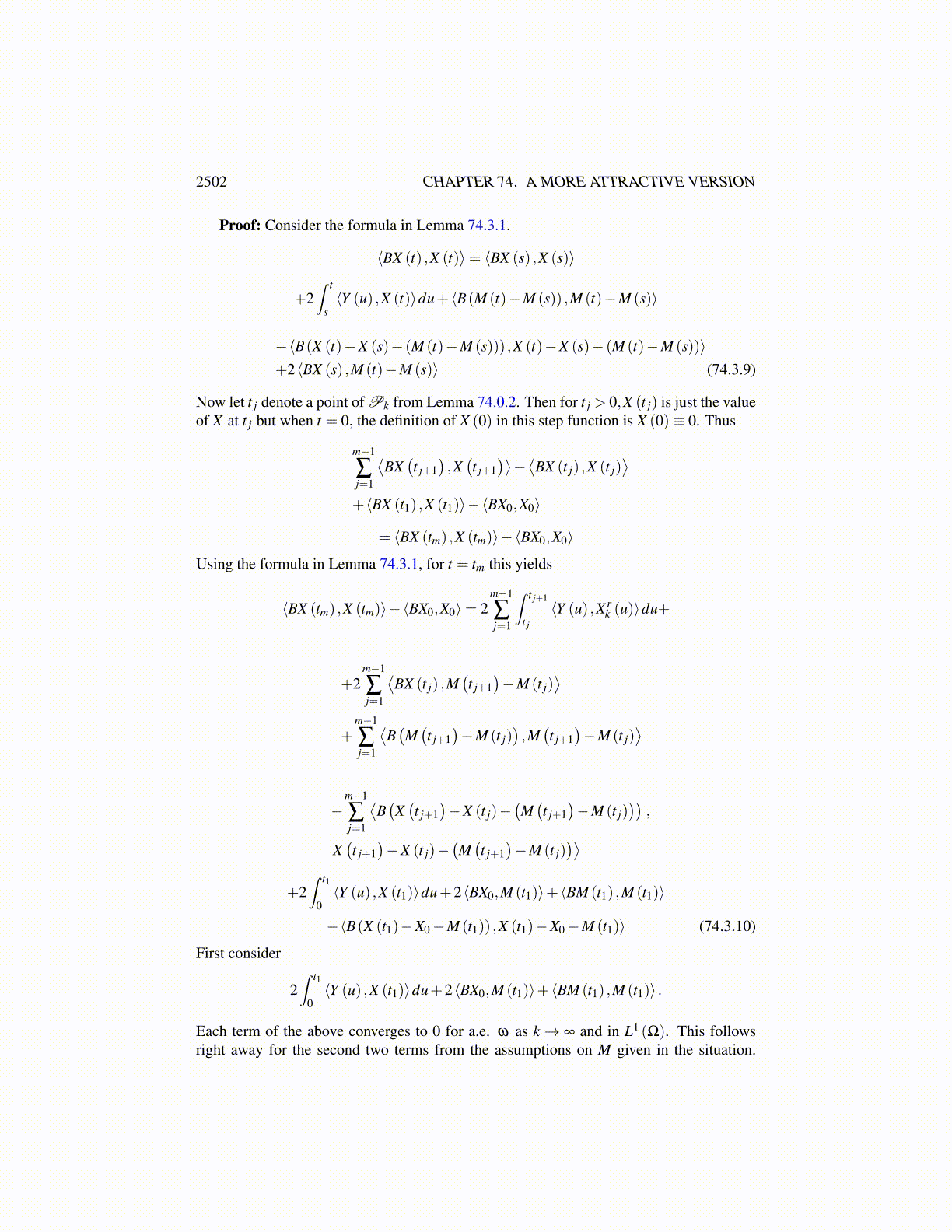
⟨BX (t) ,X (t)⟩= ⟨BX (s) ,X (s)⟩+
+2∫ t
s⟨Y (u) ,X (t)⟩du+ ⟨B(M (t)−M (s)) ,M (t)−M (s)⟩
−⟨BX (t)−BX (s)− (M (t)−M (s)) ,X (t)−X (s)− (M (t)−M (s))⟩
+2⟨BX (s) ,M (t)−M (s)⟩ (74.3.6)
Also for t > 0
⟨BX (t) ,X (t)⟩= ⟨BX0,X0⟩+2∫ t
0⟨Y (u) ,X (t)⟩du+2⟨BX0,M (t)⟩+
⟨BM (t) ,M (t)⟩−⟨BX (t)−BX0−BM (t) ,X (t)−X0−M (t)⟩ (74.3.7)
Proof: From the formula which is assumed to hold,
BX (t) = BX0 +∫ t
0Y (u)du+BM (t)
BX (s) = BX0 +∫ s
0Y (u)du+BM (s)
Then
BM (t)−BM (s)+∫ t
sY (u)du = BX (t)−BX (s)
It follows that⟨B(M (t)−M (s)) ,M (t)−M (s)⟩−
⟨BX (t)−BX (s)− (M (t)−M (s)) ,X (t)−X (s)− (M (t)−M (s))⟩
+2⟨BX (s) ,M (t)−M (s)⟩
= ⟨B(M (t)−M (s)) ,M (t)−M (s)⟩−⟨BX (t)−BX (s) ,X (t)−X (s)⟩+2⟨BX (t)−BX (s) ,M (t)−M (s)⟩
−⟨B(M (t)−M (s)) ,M (t)−M (s)⟩+2⟨BX (s) ,M (t)−M (s)⟩