2474 CHAPTER 73. THE HARD ITO FORMULA, IMPLICIT CASE
By definition, M(t j+1
)−M (t j)=
∫ t j+1t j ZdW. Now it follows, on discarding the negative
terms,
⟨BX (tm) ,X (tm)⟩−⟨BX0,X0⟩ ≤ e(k)+2∫ tm
0⟨Y (u) ,X r
k (u)⟩du+
+2∫ tm
0
(Z ◦ J−1)∗BX l
k ◦ JdW +m−1
∑j=0
⟨B∫ t j+1
t j
ZdW,∫ t j+1
t j
ZdW⟩
Therefore,
suptm∈Pk
⟨BX (tm) ,X (tm)⟩ ≤ ⟨BX0,X0⟩+ e(k)+2∫ T
0|⟨Y (u) ,X r
k (u)⟩|du+
+2 suptm∈Pk
∣∣∣∣∫ tm
0
(Z ◦ J−1)∗BX l
k ◦ JdW∣∣∣∣
+mk−1
∑j=0
⟨B(∫ t j+1
t j
Z (u)dW),∫ t j+1
t j
Z (u)dW⟩
where there are mk +1 points in Pk.The next task is to somehow take the expectation of both sides. However, this is prob-
lematic because the stochastic integral is only a local martingale. Let
τ p = inf{
t :⟨
BX lk (t) ,X
lk (t)
⟩> p}
By right continuity this is a well defined stopping time. Then you obtain the above inequal-ity for
(X l
k
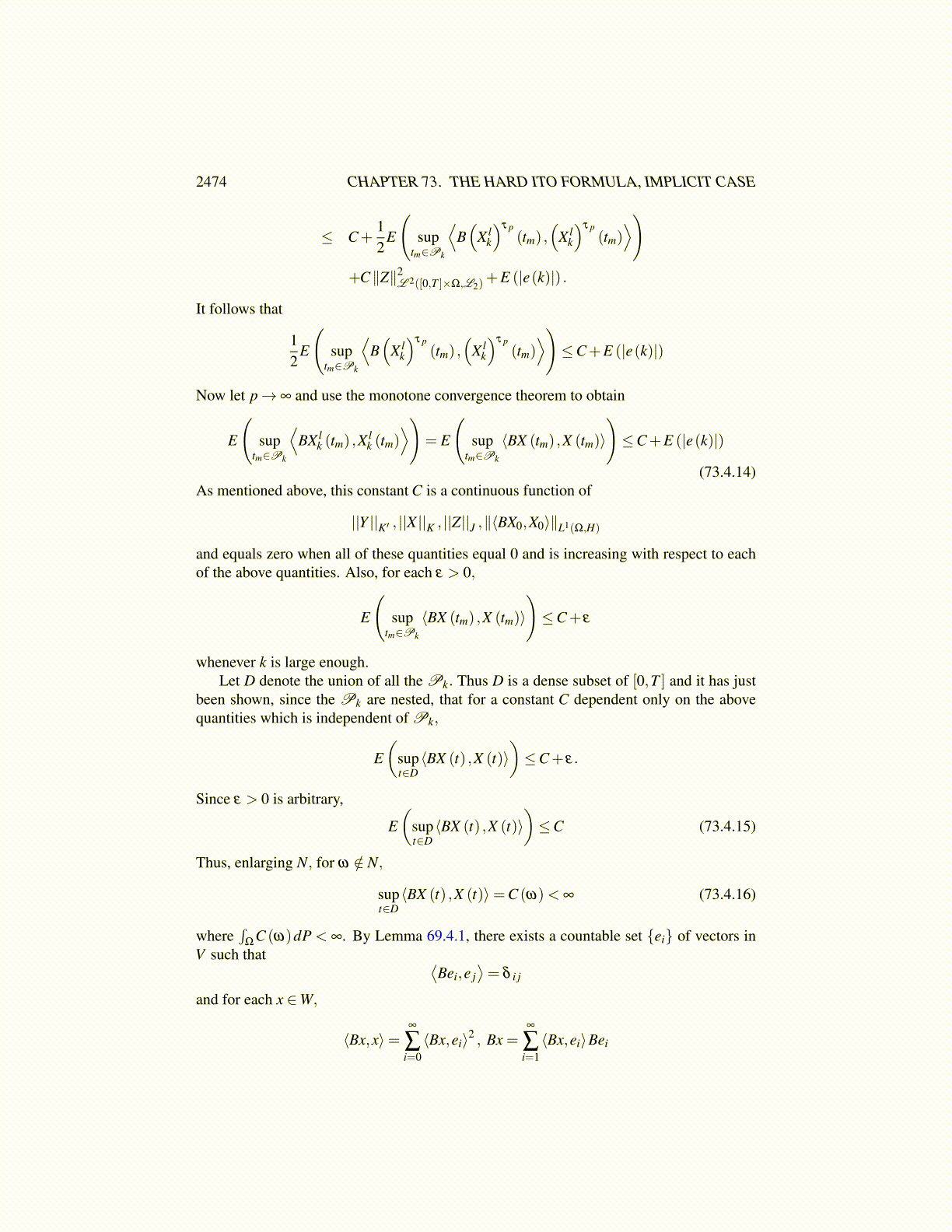
)τ p in place of X lk . Take the expectation and use the Ito isometry to obtain
∫Ω
(sup
tm∈Pk
⟨B(
X lk
)τ p(tm) ,
(X l
k
)τ p(tm)
⟩)dP
≤ E (⟨BX0,X0⟩)+2 ||Y ||K′ ||Xrk ||K
+∥B∥mk−1
∑j=0
∫ t j+1
t j
∫Ω
||Z (u)||2 dPdu
+2∫
Ω
(sup
t∈[0,T ]
∣∣∣∣∫ t
0X[0,τ p]
(Z ◦ J−1)∗B
(X l
k
)τ p◦ JdW
∣∣∣∣)
dP+E (|e(k)|)
≤C+∥B∥∫ T
0
∫Ω
∥Z (u)∥2 dPdu+E (|e(k)|)
+2∫
Ω
(sup
t∈[0,T ]
∣∣∣∣∫ t
0
(Z ◦ J−1)∗B
(X l
k
)τ p◦ JdW
∣∣∣∣)
dP≤
C+E (|e(k)|)+2∫
Ω
(sup
t∈[0,T ]
∣∣∣∣∫ t
0
(Z ◦ J−1)∗B
(X l
k
)τ p◦ JdW
∣∣∣∣)
dP (73.4.12)