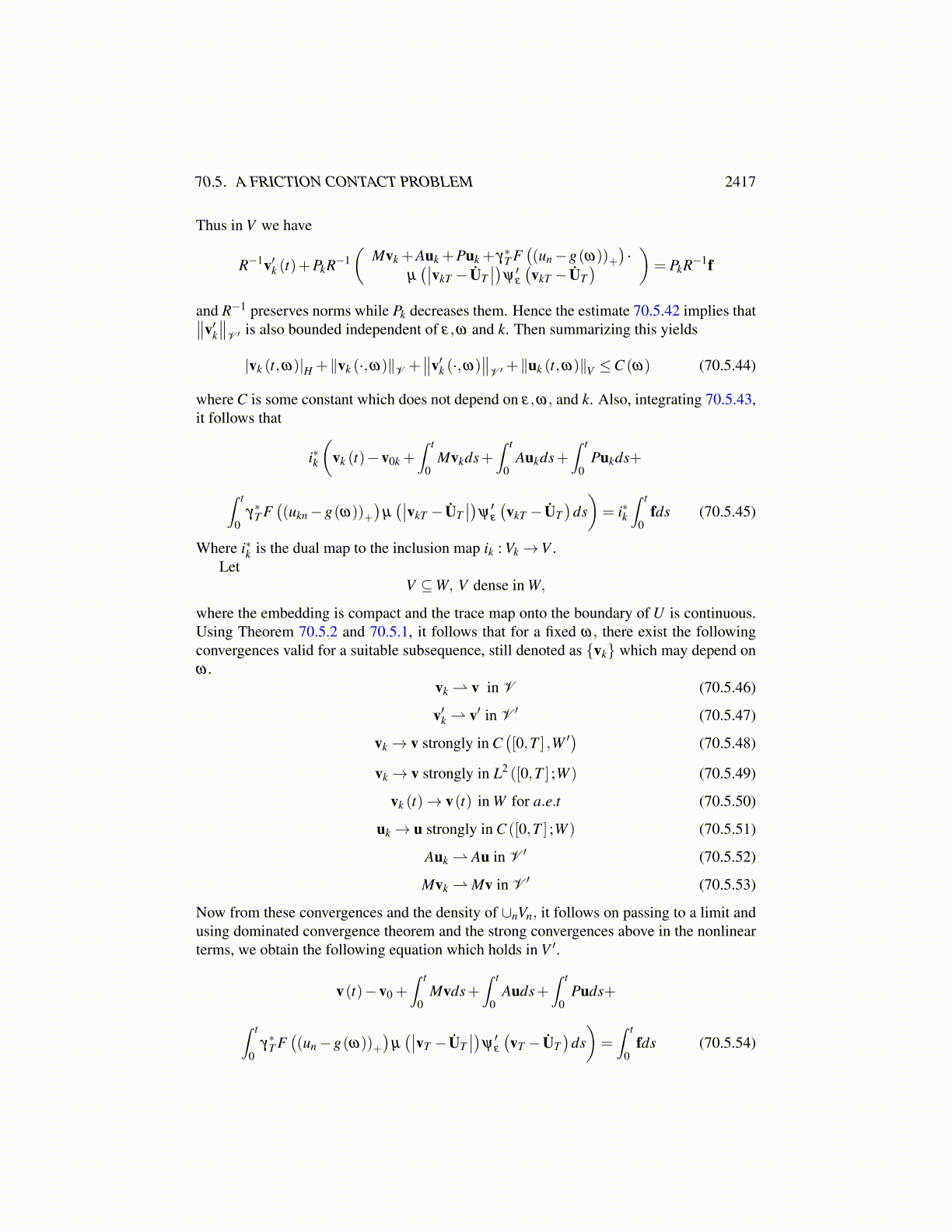
70.5. A FRICTION CONTACT PROBLEM 2417
Next consider why ∪nVn is dense in V. If this is not so, then there exists f ∈V ′, f ̸= 0 suchthat ∪nVn is in ker( f ) . But f = Ru and so
0 = ⟨Ru,ek⟩= ⟨Rek,u⟩= λ k (ek,u)H
for all ek and so u = 0 by density of ∪nVn in H. Hence Ru = 0 = f after all, a contradiction.Hence ∪nVn is dense in V as claimed.
Now we set up the Galerkin method for Problem Pε . Let
vk (t,ω) =k
∑j=1
x j (t,ω)e j, uk(t) = u0 +∫ t
0vk(s)ds
and let vk be the solution to the following integral equation for each ω and j ≤ k. Thedependence on ω is suppressed in most terms in order to save space.⟨
vk (t)−v0k +∫ t
0 Mvk +Auk +Puk + γ∗T F((ukn−g(ω))+
)·
µ(∣∣vkT − U̇T
∣∣)ψ ′ε(vkT − U̇T
) ,e j
⟩
=∫ t
0
⟨f,e j⟩
ds (70.5.41)
Here v0k → v0 ∈ H and the equation holds for each e j for each j ≤ k. Then this integralequation reduces to a system of ordinary differential equations for the vector x(t,ω) whosejth component is x j (t,ω) mentioned above. Differentiate, multiply by x j and add. Thenintegrate. This will yield some terms which need to be estimated. Here is the one whichcomes from the long term.∫ t
0
∫ΓC
F((ukn−g(ω))+
)µ(∣∣vkT − U̇T
∣∣)ψ′ε
(vkT − U̇T
)·vkT dSds
=∫ t
0
∫ΓC
F((ukn−g(ω))+
)µ(∣∣vkT − U̇T
∣∣)ψ′ε
(vkT − U̇T
)·(vkT − U̇T
)dSds
+∫ t
0
∫ΓC
F((ukn−g(ω))+
)µ(∣∣vkT − U̇T
∣∣)ψ′ε
(vkT − U̇T
)· U̇T dSds
The first of these is nonnegative and the second is bounded below by an expression of theform
−C∫ t
0
∫ΓC
(1+ |ukn|)∣∣U̇T
∣∣dSds ≥ −C∫ t
0∥uk∥W
∥∥U̇T∥∥
L2(ΓC)3 ds−C
≥ −C∫ t
0∥uk∥W −C
Where W embedds compactly into V and the trace map from W to L2 (ΓC)3 is continuous.
In the above, C is independent of ε,ω and k. To estimate the term from P one exploits thelinear growth condition of P in 70.5.22 to obtain a suitable estimate.